Sunday, May 20, 2018

Ozyptila praticola In Tree Trunk Moss On The Tolt River

Site location map. Pin and squares indicate cone and moss
samples, respectively. Blue, yellow and red markers indicate
adult O. praticola, juvenile O. ?praticola, or no O. ?praticola
found, respectively.
Since learning a few months ago that the European crab spider Ozyptila praticola  (Thomisidae) can be found in tree trunk moss, I've been working my way up a few river valleys, sifting moss, in my ongoing search for the edges of O. praticola's local range. I just completed one such river series along Tolt River. Tolt River is a tributary to the Snoqualmie River, and runs along the southern edge of Carnation, Washington in King County.

Artifacts indicate past land
use as home sites.
I visited three Tolt River sites on 12 May, then an additional three sites on 18 May. The sites spanned a distance of approximately 5.3 river miles (squares on map, above). The stretch of the river valley I sampled is lightly peppered with currently occupied homes interspersed with former home sites that are being restored as part of the Tolt River Natural Area salmon habitat protection initiative. As far as I could determine from historical aerial photos on Google Earth, many of my sample sites had homes on them as recently as three to seven years ago.

I had tapped O. praticola from cones in Carnation in 2016 (blue pin in map above), so I knew that the species was in the neighborhood. But I didn't know if it had spread into the more natural habitats found along the Tolt River. Rod Crawford didn't find any O. praticola in 2009 when he collected spiders on the west side of Snoqualmie River at Tolt River–John MacDonald Memorial Park.

From parking lot, a view through a
strip of riparian forest to the Tolt River.
Male O. praticola sifted from
tree trunk moss at first site.
My first, most downstream site was located in a wooded riverside parking area near where Route 203 crosses Tolt River. I sifted about a sweep net full of moss from the trunks of black cottonwood (Populus trichocarpa) and bigleaf maple (Acer macrophyllum) and collected 1 female, 2 male and 40 juvenile O. praticola. Ozyptila praticola was by far the most numerous species present in the sample.

Mossy riparian cottonwoods at third
site, where a home formerly stood.
Male O. praticola sifted from
tree trunk moss at third site
The moss I sifted at the next site upstream produced a dozen juvenile O. probably-praticola, but no adults. Moss at the third site, however, mirrored the first in producing 2 female, 2 male, and 20 juvenile O. praticola.

Mossy maple at final up-
stream site.
Female O. praticola sifted from
tree trunk moss at most upstream
site.
Although young thomisids were present at the fourth and fifth sites, I didn't find any spiders that I could with any confidence identify as O. praticola. But at the final, most upstream site, I sifted 1 female and 2 juvenile O. praticola from moss I harvested from bigleaf maple and black cottonwood trunks.

Clearly, O. praticola is present along the Tolt River for at least the first 5.3 river miles from its confluence with Snoqualmie River. This finding then raises the question, has it spread even farther upstream? If the species is simply following the riparian forest upstream, it seems reasonable to anticipate that it may have spread even farther upstream than where I stopped sampling. However, if it is present at these sampling sites only because it was inadvertently introduced by former homeowners, then it may not have spread upstream beyond the homesteaded areas much if at all. The only way to know for sure is to continue sampling farther upstream. But unfortunately, road access is restricted farther upstream. Anyone have a canoe?

The effort to revegetate former housing sites is under way.

Thursday, May 10, 2018

2-May-2018 Lynden, Washington

Site location map. Pins show places I tapped cones in 2017.
Red and yellow indicate no or juvenile O. praticola found,
respectively, in cones (pins) or tree trunk moss (square).
Blue star indicates male P. lanigera collection site.
The small farm-oriented city of Lynden was Rod Crawford's and my destination this day. Having tapped cones at four locations in this northern Whatcom County enclave late last September, I didn't expect to see anything too different this time around. Boy was I wrong!

Male P. lanigera on
building exterior
The excitement began at our first stop at the Northwest Washington Fairgrounds (blue star on map above). After an uneventful start of picking spiders from the chain-link fence and some stacked concrete barriers, I moved on to building exteriors and came face to face with a male Pseudeuophrys lanigera (Salticidae). First discovered in North America by yours truly less than three years ago, the species appears to be rapidly expanding its range in the Pacific Northwest. In addition to the findings we've reported to-date, in March of this year Sean McCann found both male and female P. lanigera on the exterior of a building at the Vauncouver International Airport in Richmond, British Columbia. And just this week, a high school student in "the other Vancouver" here in Washington found what appears to be a male P. lanigera in her school's cafeteria. The latter ID is still pending, but it is clear that spider enthusiasts along the west coast should keep their eyes peeled for this tiny salticid.

Bender Fields cone source was a border
of planted Douglas-fir and red-cedar trees
paralleling Fish Trap Creek.
After sweeping marsh grass next to Fish Trap Creek, which borders the fairgrounds, we moved on to Bender Fields for my next surprise of the day. I had tapped 50 Douglas-fir (Pseudotsuga menziesii) cones there the previous September and found three identifiable species, all common linyphiids: Erigone aletris, Tachygyna vancouverana, and Tenuiphantes tenuis. The same species were present this day, as well another introduced spider, Lathys humilis (Dictynidae). I had collected L. humilis in nearby Blaine in February, 2017, so it's presence wasn't a really big surprise.

Penultimate female O. praticola
on a Douglas-fir cone scale, looking
very much like a conifer seed.
What did surprise me at Bender Fields was the presence of numerous penultimate Ozyptila probably-praticola (Thomisidae), the introduced European crab spider I didn't find anywhere in Lynden last year. Open cones being plentiful this visit (they were in short supply last September), I tapped 150 in hopes of collecting a mature specimen, but no dice. Still, I did collect 16 juveniles and penultimates, so Rod and I each brought home a penultimate to rear to maturity to prove the presence of the species.
UPDATE [17 May 2018]: The penultimate female I was rearing has molted to maturity. Ozyptila praticola is now confirmed in Lynden, Washington.

A little bit of moss...
Rod also collected one juvenile O. probably-praticola from leaf litter from the creekside edge of Bender Fields, but overall there were very few spiders in that microhabitat. With an eye towards finding him a more productive habitat as well as finding me some tree trunk moss to sift for possible O. praticola, we headed for the banks of the nearby Nooksack River.

...can hold so many Ozyptila.
Not for the first time this day, I had to wade through thickets of Himalayan blackberry (Rubus armeniacus) to reach my destination. In this case, my destination was a group of mature cottonwood trees (Populus trichocarpa) with mossy trunks. I was only able to collect half a sweep net-full of moss, but that small quantity harbored an astounding 42 juvenile O. probably-praticola. The thorny slog through the living barbed wire that is blackberry was very much worth the information I was able to gather from the moss on the other side.

Sunday, May 6, 2018

30-April-2018 Tacoma, Washington

Site location map. Pins and cross indicate cone and
litter samples, respectively.
After recently finding juvenile Ozyptila on the campus of University of Puget Sound, I was convinced that the introduced crab spider Ozyptila praticola (Thomisidae) was present there. But I lacked a mature specimen to prove it. I thought that Rod Crawford or I might turn one up during the Point Defiance Park BioBlitz, especially in the anthropogenic southern part of the park, but that didn't happen. So I returned to north Tacoma this day to sift more litter from the university's "Ozyptila hot spot", and tap more fallen cones until I found a mature Ozyptila (of whatever species).

I debated whether to begin my day sifting litter or tapping cones. Since Rod and I had spotted some nice cone deposits near Pearl and 21st on our way to the BioBlitz a few days before, I decided to tap cones first. As eager as I was to sift litter at the Ozyptila hot spot, I didn't want to risk losing good cones to groundskeepers. I have occasionally seen them removed before my very eyes. It is a story almost too sad to tell...

In total, I tapped 250 pine cones: 150 black pine (Pinus nigra) cones from three sites, and 100 western white pine (P. monticola) cones from two sites. Though each set of cones produced a set of spiders unique in composition, taken together they provided a fairly typical urban sample. From the 250 tapped cones I collected 76 spiders and 9 identifiable species. A few points of interest:

  • I tapped female Rugathodes (Theridion) sexpunctatum from cones at two sites. It's a common enough native spider -- we collected it in multiple microhabitats in Point Defiance Park, for example -- but I had only found it in the fallen cone microhabitat twice before in western Washington. So the present samples doubled my cone tally.
  • Cryptachaea blattea is an introduced theridiid that I've tapped frequently from cones in western Washington, from Pierce County in the south to Skagit County in the north. But today it seemed especially prevalent; I tapped it from cones at three of the five sites.
  • Another introduced crab spider, Philodromus dispar, is a species I tap frequently from cones in western Washington, albeit usually as juveniles (penultimate males can be distinguished from congeners by their round palps). This day, however, I tapped several mature males from cones. Checking my records, I found that the four other times I tapped males from cones were in the first two weeks of May, quite consistent in timing with these April 30th samples in Tacoma.
  • No O. praticola!
"Dirty" Arbutus litter full of fines...
...including a fine female O. praticola!
Having found no O. praticola in the cones, I returned to the Ozyptila hot spot to sift litter. I first sifted a net-full of oak leaf litter because I knew it would be "clean". That is, it would be easy to examine the siftings because the litter was relatively free of dirt and organic particles small enough to fall through the sifter. The oak leaf litter, however, produced no O. praticola, not even juveniles. Next I switched to litter under the Arbutus unedo shrubs from which I'd originally captured juvenile O. praticola in cardboard live traps. This batch of litter consisted of A. unedo leaves, heavily decayed wood chip mulch, and Douglas-fir (Pseudotsuga menziesii) needles, which are quite short. In other words, "dirty" litter that largely fell through the sifter. Lucky for me, along with it fell a female O. praticola, hurray! 

Ozyptila praticola is now confirmed as present in Tacoma. However, its present distribution appears to be extremely localized.
The many places I've looked for but not found Ozyptila praticola
in Tacoma (red), and the one place I have (blue).


Friday, May 4, 2018

27-April-2018 Tacoma, Washington

Site location map. Click to enlarge.
I was very happy when Rod Crawford and I were invited to participate in Point Defiance Park BioBlitz 2018. The park's 760 acres of mature forest, shoreline habitats, zoo and botanical gardens caps the north end of the peninsula that is Tacoma, and is usually closed to collectors. Participating in the BioBlitz allowed Rod and me to explore the spider fauna of this gem to the benefit of both the park and the Burke Museum, while also giving me another opportunity to search for the introduced European crab spider Ozyptila praticola (Thomisidae).

And speaking of O. praticola, on our way to the park, Rod and I made a brief stop at University of Puget Sound to check a live trap that I'd placed there the week before. I had hoped it would contain mature O. praticola, proving the presence of the species that I'd so far only collected there as juveniles. Alas, it wasn't to be; the trap was empty.

Rod sifts leaf litter at Owen Beach as
one of our very helpful high school senior
assistants inputs IDs into iNaturalist.
We spent a good part of our day in the park collecting at Owen Beach. This location gave us access to numerous habitats, including shoreline conifers, understory vegetation, tree trunk moss, buildings, and leaf litter.

Antrodiaetus sp. juvenile
Many specimens were of course too tiny to identify in the field for BioBlitz purposes, but we were able to find some exciting larger specimens for our assistants to photograph and input into the iNaturalist database. This folding-door spider (Antrodiaetus sp., family Antrodiaetidae), for example, was one of the more photo-worthy spiders I sifted from moss.

Cone source in the native plant garden.
The Meadow is to the left.
After we completed our work at the beach, a field assistant very helpfully directed us to the park's Northwest Native Plant Garden as a place where we might find uncut grass to sweep. (The other potential location, the zoo's muskox paddock, didn't sound like a wise choice...) While Rod swept "The Meadow", I tapped 100 fallen Douglas-fir (Pseudotsuga menziesii) cones from the bordering stand of young trees that had apparently been planted as a buffer zone.

Cybaeus sp.
Cybaeus exuvium (center) and
spider (arrow)
All that cone tapping only produced eight spiders, but three species were identifiable. One of them, Linyphantes nehalem (Linyphiidae), we didn't collect in any other microhabitat this day, nor had I ever tapped it from cones before. Less interesting for the species list, but certainly interesting from an ecological perspective, was this teneral juvenile Cybaeus (Cybaeidae) and its exuvium. It had used the cone as a molting place.

Lots of cones in the parking
lot border
Open cones in lush litter
By this time I was pretty tired, and my stomach was beginning to rumble for the promised BioBlitz taco bar. But I couldn't bear the thought of not tapping the fallen black pine (Pinus nigra) cones I had noticed on our drive from Owen Beach to the native plant garden. Black pines were among the row of conifers that had been planted as a visual barrier between the main parking lot and a maintenance yard, and they had dropped a lot of cones. I again tapped 100 cones and again found few spiders -- this time only six. In contrast to the cone spiders from the native plant garden, however, of the two species identifiable here, the one we didn't find in any other microhabitat this day was the very common introduced species Tenuiphantes tenuis (Linyphiidae). Among spiders identifiable to species, I've found T. tenuis at more cone sampling sites in western Washington than any other species except O. praticola.

You can read Rod's take on the day here.
As afternoon shifted towards evening, black-tailed deer
(Odocoileus hemionus columbianus) began appearing.

Monday, April 23, 2018

21-April-2018 Edmonds, Lynnwood, and Mill Creek, Washington

Site location map. Click to enlarge.
Red pins: no O. praticola found
Blue pins: O. praticola confirmed with adult specimen
I've been so busy setting and checking cardboard live traps recently that I've hardly tapped any cones. This is because I set traps in places that generally don't have accessible fallen cones but where I still need to check for the presence of the introduced crab spider, Ozyptila praticola (Thomisidae). So as a rule, when I'm out trapping, I'm not tapping. On this day, however, I needed to chauffeur someone to and from an all-day event in Lynnwood, which put me in a highly developed part of Snohomish County where pines are a common landscaping plant. I've collected juvenile Ozyptila probably-praticola in Lynnwood and in nearby Mill Creek in previous years. Now I had an opportunity to (hopefully) confirm those IDs with mature specimens, and maybe document a few additional sites. And I could do that by once again tapping cones!

Brackett's Landing, Edmonds

Row of shore pines viewed from
nearby bluff. Railroad tracks in fore-
ground, Puget Sound in background
A shore pine cone
My first stop was the shoreline park Brackett's Landing. Though it was only 8:30 in the morning, the parking lot was already full of SCUBA divers readying their gear for a tour of the Edmonds Underwater Park. My destination was a little closer and a lot drier: the row of shore pines (Pinus contorta contorta) buffering the view between the restroom building and the railroad tracks. Cones were lying on a variety of substrates including wood mulch, pine litter and grass. I tapped 100 cones and collected 12 spiders from 6 families. All spiders but one were juveniles.

Female Pseudeuophrys lanigera,
ventral view
Female P. lanigera,
dorsal view
The spiders I tapped from these cones were typical for an urban cone sample in this region (Enoplognatha, Philodromus, Tenuiphantes, etc.), with one exception: Pseudeuophrys lanigera! I first discovered this European salticid in fallen pine cones in Mukilteo in 2015. Since then, I and others have found more P. lanigera in Seattle and Bremerton. You can read our paper about those discoveries here. This find in Edmonds, which is located between Mukilteo and Seattle, is consistent with those earlier findings. It also indicates that the initial discovery of the species in the fallen cone microhabitat was not a fluke. I didn't find any O. praticola in this set of cones.

Meadowdale Neighborhood Park, Lynnwood

Park woodlands habitat
Fallen Douglas-fir cones
My plan had been to tap Douglas-fir (Pseudotsuga menziesii) cones in the more naturalistic setting of Lynndale Park. There were no parking places to be found there, however, due to a little league baseball event. But soon enough, a little meandering brought me to Meadowdale Neighborhood Park, which featured semi-natural stands of Douglas-fir and western red-ceder (Thuja plicata). Tapping 75 Douglas-fir cones produced 8 spiders from 3 families. Cryphoeca exlineae (Hahniidae) and Tachygyna vancouverana (Linyphiidae) were identifiable to species. No O. praticola were found.

Mill Creek Post Office

Ivy with a buzz cut...
...made cones nestled in the
ivy's matrix more visible.
At this point I was not far from an urban spot in Mill Creek where I'd tapped juvenile O. probably-praticola twice before from fallen eastern white pine (P. strobus) cones. Since I still needed a mature specimen from there to confirm the species ID, I decided to give those cones one more try. After that, my plan was to continue eastward to Willis Tucker Park for another attempt at cone tapping in a less developed forest setting.

Groundskeepers had recently given a "haircut" to the very thick bed of English Ivy (Hedera helix) growing under my cone source. This had the great benefit of making cones much more visible and accessible. But it may have also chased the spiders away; I tapped 75 fallen cones and collected only one spider. But it was a good one! A female O. praticola!

Alderwood Mall, Lynnwood

Oh hail.
So much for plans! Just as I reached Willis Tucker Park, a soaking rain began to fall. I decided to head back to Lynnwood, but stop off in Tambark Creek Park along the way to see if it might be another good future spot for collecting. In the few minutes it took me to get there, the rain had turned to hail. Ah, spring!

Alderwood Mall cone source
Despite the foul weather just a few miles east, I was pleased to find that Lynnwood had remained dry. I decided to drive around the Alderwood Mall area in search of some "mall pine" (black pine, P. nigra) cones to tap. I didn't have far to look. A row of black pines growing behind a vitamin shop had dropped numerous cones onto a bed of pine needle litter and sparse English ivy below. The scales of most cones were at least partially open, which isn't always the case with fallen black pine cones. I tapped 50 cones and surprisingly got a result very like Mill Creek. That is, the only spider species present in the cones was O. praticola, this time represented by two females.

Magnolia against a glowering sky

Sunday, April 22, 2018

20-April-2018 Tacoma, Washington

Site location map. Markers indicate traps in which no Ozyptila
 (red) or juvenile Ozyptila (yellow) were found.
I've tapped a lot of fallen conifer cones in Tacoma in my search for the introduced crab spider Ozyptila praticola, but never in the city's north end. So I decided, back on April 1st, to deploy a set of cardboard live traps in shrubs in that part of the city. I returned on the 20th to see who had moved into them in the mean time.

The long and the short of it is that, while all traps contained spiders (clubionids were the most common), only one trap contained any Ozyptila. The trap, wedged into a low fork in an Arbutus unedo shrub growing on the campus of University of Puget Sound, contained two juvenile Ozyptila that looked like praticola.

Not wanting to go home without being able to confirm which Ozyptila species I had found, I proceeded to tap a set of 50 Pseudotsuga menziesii cones which had fallen near the Arbutus. No luck! Next, I sifted two full bags of leaf & needle litter. Frustratingly, that exercise only turned up more juvenile O. ?praticola. Well, at least I know where to resume my search next time I'm in north Tacoma. I placed a new trap in the Arbutus and called it a day. If this does turn out to be O. praticola, it would appear to be a highly localized population.

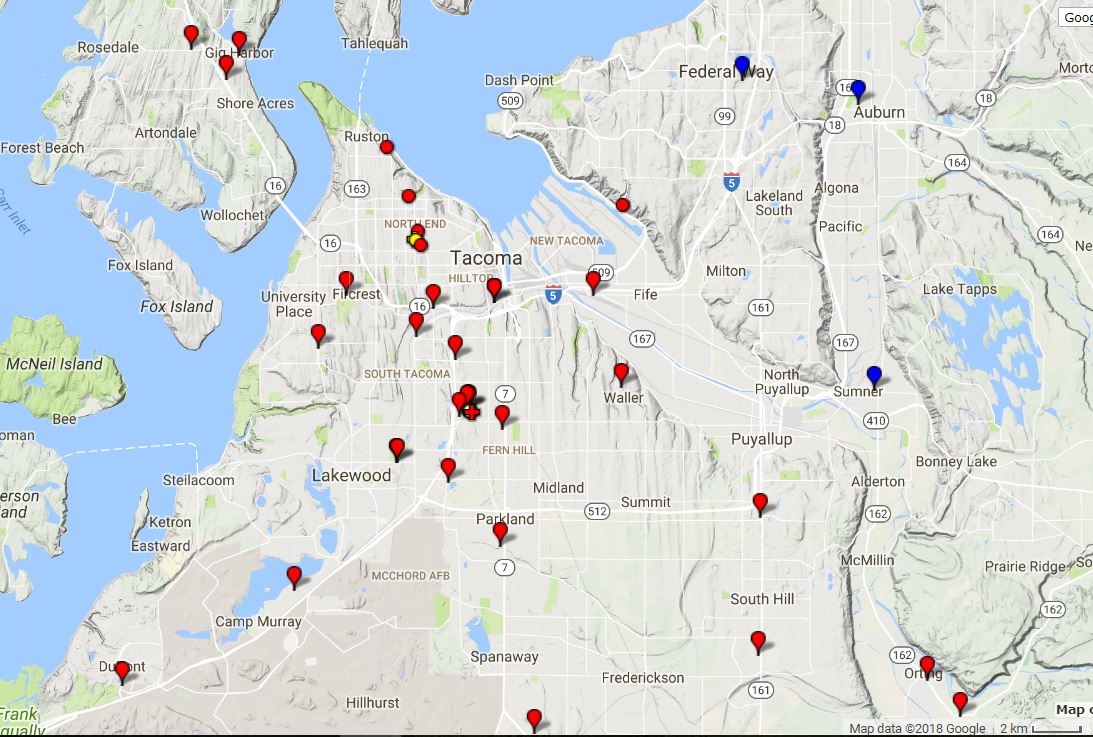
Tacoma-area fallen cone (pins) and live trap (circles) samples.
Blue -- Ozyptila praticola confirmed with adult specimen
Yellow -- Ozyptila?praticola juveniles found
Red -- No Ozyptila found


Thursday, March 22, 2018

Cardboard Live Traps Extend Known Range Of Ozyptila praticola In Washington

Map of cardboard live trap sites deployed 11-Feb-2018
between Monroe and Gold Bar, Washington.
Until quite recently, I have been able to investigate the local range of the introduced European crab spider Ozyptila praticola (Thomisidae) as a part of my ongoing survey of the fallen conifer cone microhabitat in western Washington. This is because O. praticola uses the fallen cone microhabitat when it is available. Unfortunately, the fallen cone microhabitat isn't always available in places I want to search for O. praticola. This has become problematic as I seek to fine-tune my understanding of the current boundaries of O. praticola's local range.

To remedy this, I have started sampling additional microhabitats that I know O. praticola can be found in, including moss and litter. While this has been useful in specific localities, as with fallen cones neither of these microhabitats is reliably present or accessible in all of the places I wish to sample. In response to this situation, I created cardboard live traps, an artificial microhabitat that, theoretically, I can deploy along sampling transects virtually anywhere.

March, 2018 temperature history for Monroe, Washington. Graph modified
from Wunderground. The orange line represents the 50 F (10 C) isotherm.
Click to enlarge.
I deployed my first transect of live traps along the U.S. Hwy 2 corridor between Monroe and Gold Bar, Washington, on 11 Feb. 2018. I then waited until daytime temperatures peaked above 50 degrees Fahrenheit (10 Celsius) and nighttime lows remained above freezing for several consecutive days before checking the traps for spiders. I chose those parameters under the assumption that overwintering O. praticola would become mobile enough to start entering my traps under those conditions. But it was all guesswork; I'm learning as I go.

Penultimate male Ozyptila praticola
in a cardboard live trap in Monroe,
Washington
I had deliberately anchored the western end of the transect in a particular locality in Monroe where I already knew O. praticola was present. My plan was to use the Monroe traps as a bellwether that O. praticola had indeed become active and thus it was worth my time to check rest of the traps in the transect. On 19 March, the 10th consecutive day of my prescribed weather conditions, I checked the traps in Monroe and found one penultimate male O. praticola in each. I considered this the "go" signal and proceeded to check the other traps in the transect.

This cardboard live trap at the base of
a Mahonia shrub in downtown Sultan
harbored a female O. praticola.
Traffic issues and time constraints prevented me from checking three of the traps (pink pins on the map, below), while some traps were missing entirely (white pins). Nevertheless, I was able to find and check enough traps between Monroe and Sultan to learn, by the presence of juvenile Ozyptila in them, that O. praticola was likely present in those localities (yellow pins). Further searching for adults would have been warranted in those places had I not also recovered a mature female O. praticola from a trap a bit further east, in downtown Sultan (blue pin). I found no Ozyptila in any trap east of downtown Sultan.

Transect results. See text for pin color code. Some pins removed for clarity.
This set of cardboard live traps helped refine our knowledge of the extent of O. praticola's local range. Prior to this experiment, Monroe was the eastern-most place along the U.S. Hwy 2 corridor where I had confirmed the presence of O. praticola with a mature specimen. It is now clear that O. praticola is present at least as far east as downtown Sultan.