Friday, November 13, 2015

12-Nov-2015 Issaquah, Washington

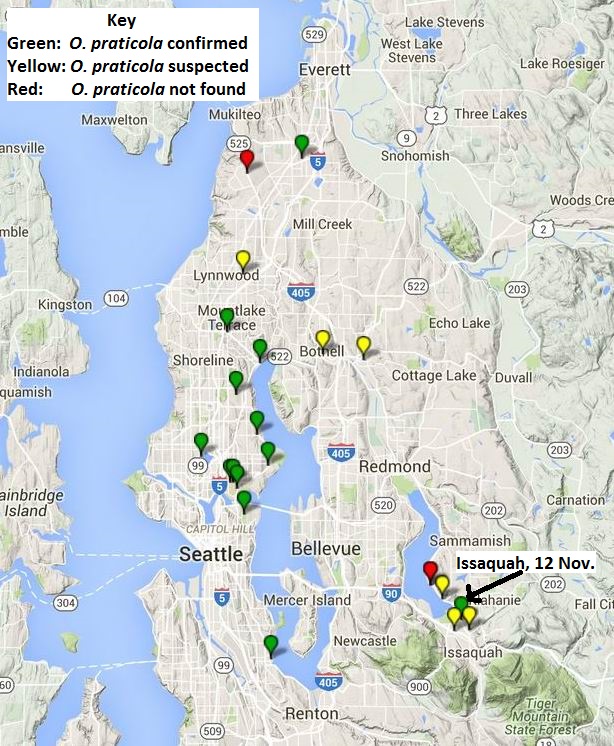
Known distribution of Ozyptila praticola
in Washington (so far)
After finding juvenile Ozyptila that were colored and patterned like praticola almost everywhere I looked in Seattle's eastern suburbs, I was convinced that the introduced thomisid was present east of Lake Washington.  But I lacked an adult specimen to prove it.  Until now, that is!

I returned to my previous sampling location in Issaquah, knowing that there were some untapped cones there dropped by "weeping" white pines (probably Pinus monticola 'Pendula').  This being late autumn, and judging from my recent experiences, I knew the likelihood of finding an adult Ozyptila praticola in any particular cone was not high.  But I also knew that the likelihood would increase with each cone I tapped.

My cone source was three ornamental
'weeping' pines
The strong winds predicted for the day had already begun to gust by the time I reached Issaquah.  This complicated the sorting of my tapping samples, but at least I didn't get rained on!  Once I started rooting around for P. monticola cones, I was pleasantly surprised to find 65 of them to tap.  The high count wasn't obvious at first because so many were hidden in and under the juniper bushes growing around the pines.

Fallen cones on shrubs, needle litter
and pavement.
Despite the bounty of cones, this was not a very productive set.  I only tapped 7 spiders from them -- a very low density of 0.11 spiders per cone when compared to the density of 1.43 I found a week earlier in nearby Woodinville.  However, one of those spiders was an adult female O. praticola!

Weather may force me to suspend further eastward sampling until spring.  Until then, I will probably refocus my search southward, towards Tacoma.

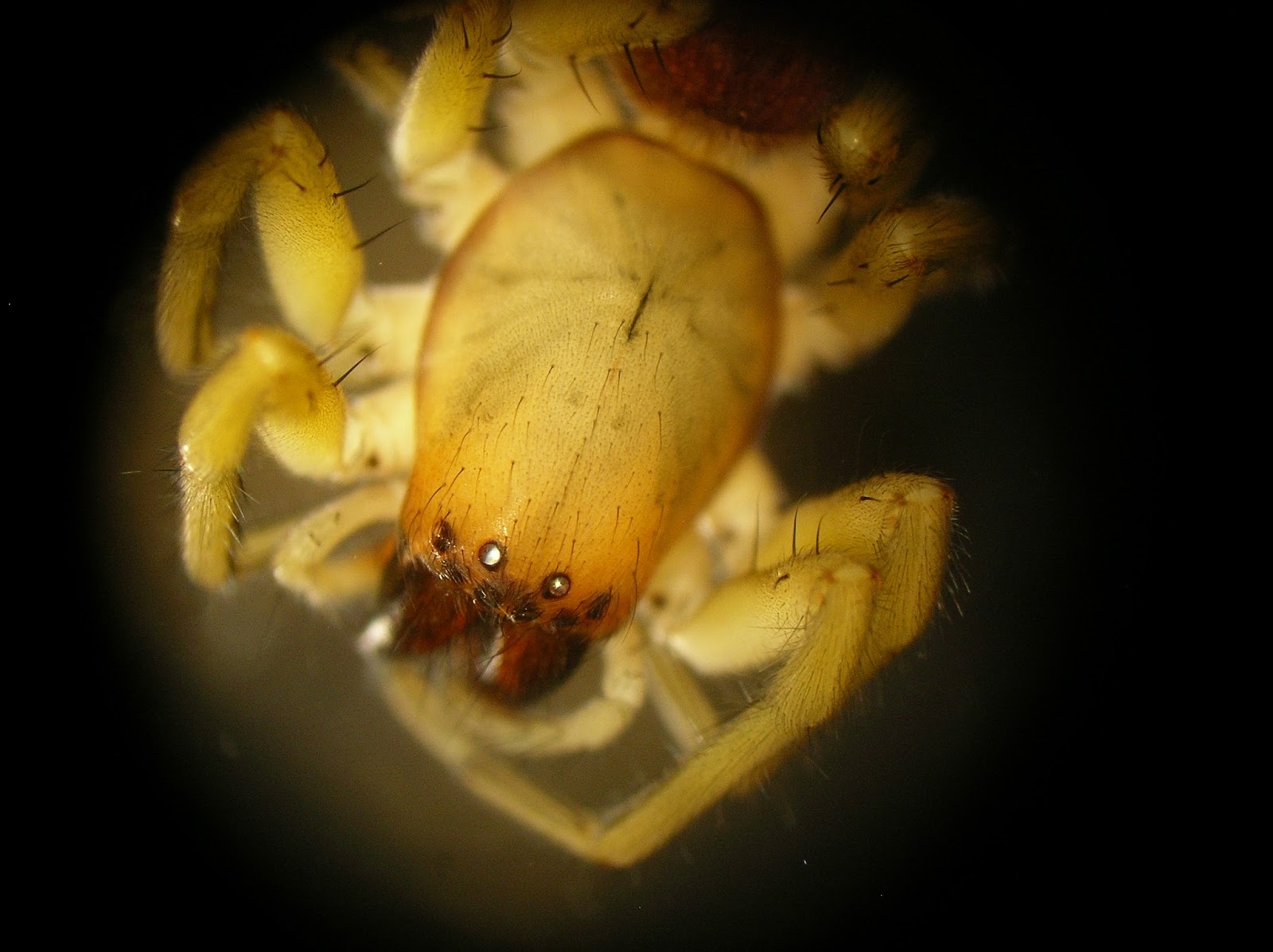
The star of the show, a female Ozyptila praticola from Issaquah, WA

Thursday, November 12, 2015

3-Nov-2015 DeYoung Park, Woodinville, Washington

Site location map. Click to enlarge.
The weather wasn't dry enough for a regular field trip with Rod Crawford, but it was just fine for tapping pine cones.  I chose Woodinville's shopping area for my destination and quickly spotted a huge western white pine (Pinus monticola) growing in tiny DeYoung Park (only 0.6 acres!).  The park is surrounded by parking lots and businesses and, like most urban parks, is kept clear of "tree trash".  However, I did manage to scare up 23 cones, many of which had escaped the groundskeeper's rake by falling into the Spiraea shrubs that were growing around the pine tree.

Huge pine tree in tiny park
Cones and needles accumulated
in Spiraea
I tapped 33 spiders from those 23 cones!  That averages 1.43 spiders per cone, which is the highest density I've collected so far this year in western Washington.  Twenty-one of them were juvenile Ozyptila (Thomisidae) colored and patterned like praticola.  And as usual I collected several juvenile Enoplognatha (Theridiidae) that look like ovata. A male theridiid still awaits identification.

Female Cryptachaea blattea tapped
from pine cone
What a stately pine
I also found several Cryptachaea blattea (Theridiidae) in this cone sample.  I've tapped this cosmopolitan species before from cones at other sites in the Seattle conurbation, but until now I hadn't gotten around to identifying it.

UPDATE [19-Aug-2017]: I again tapped fallen western white pine cones in DeYoung Park. Thirty-nine tapped cones produced 64 spiders, including a female O. praticola. This sample confirms the presence of O. praticola at this location.

A sprig of Spiraea still in bloom!

Tuesday, November 10, 2015

27-28 Oct 2015 Southeast Of Lake Sammamish, Washington

Sample site locations. Click to enlarge.
My family and I have been systematically hiking our way through the entire regional trail system in King County, Washington.  Since this activity has coincided with my effort to discover the local distribution of the introduced crab spider Ozyptila praticola (Thomisidae), I had my net and vials with me on 27 October when we hiked the lower end of the East Lake Sammamish Trail and happened to find pine trees that had dropped open cones in an accessible spot.  Finding accessible pine cones had been difficult along this particular trail, since virtually every parcel along it is privately owned and most trailside pines had dropped their cones on the private side of the ubiquitous fences.

27 Oct: Southeast Lake Sammamish

SE Lake Sammamish sampling site
Fallen P. monticola cone in
salal (Gaultheria shallon)
Two huge old western white pines (Pinus monticola) growing close to the trail had dropped numerous cones, many of which had been pressed into the mud by vehicles.  But I was able to find 15 intact cones to tap, and those cones produced 21 spiders and 2 identifiable species as well as some harvestmen.

Microneta viaria epigynum
The introduced linyphiids Tenuiphantes tenuis, Microneta viaria and Enoplognatha sp. (probably ovata) accounted for half of the spiders present.  As for Ozyptila, I collected one juvenile specimen.  It had praticola coloration and patterning, so I'm pretty sure that the species exists east of Lake Sammamish.  However, I cannot prove it with this specimen.

28 Oct: Issaquah

Issaquah sampling site
Fallen P. nigra cones under
juniper shrubs
The following day, I decided to return to the same general area and see if I could find any adult O. praticola specimens.  If the adult season for the local population is the same as it is for its British population, then the odds were quickly decreasing that I'd find many more adult specimens before spring.  However, with the rainy season already having begun, I couldn't pass up the opportunity that this not-entirely-soggy day presented to make one last effort.

Black pine (P. nigra) trees planted in front of a local business provided me with 45 tappable cones and 14 spiders.  Half of them were Ozyptila, but they were all juveniles, and all praticola in appearance.  The day before, I had thought that there was nothing more annoying than finding one juvenile Ozyptila probably-praticola, but I was wrong.  It was much more annoying to find seven of them!
A flock of cackling geese (Branta hutchinsii) in flight over Lake Sammamish

Wednesday, October 28, 2015

25-Oct-2015 Nooksack Cemetery, Everson, Washington

Sample site. Click to enlarge.
Wanting to get in at least one more field day before the rain switch gets flipped and Washington's wet season begins in earnest, Rod Crawford and I headed up to Everson in Whatcom County.  We spent most of the day collecting spiders in and around the Nooksack Cemetery and neighboring Nooksack Elementary School before tapping a round of pine cones in Everson on our way home (interesting area history here).

Nooksack Cemetery
Juvenile Xysticus sp. on a headstone
The cemetery and school sit atop the end of a tongue of elevated land bordered by a wooded Breckenridge Creek and the highly cultivated Sumas River floodplain.  While Rod dove headlong into his search for productive leaf litter at the foot of the bluff, I began searching the headstones and grave markers for eight-legged life.

Zygiella atrica in a retreat
on a headstone
Araniella displicata on headstone
Orb-weavers, crab spiders, linyphiids and the jumping spider Salticus scenicus (Salticidae) made up the bulk of my "rock collection".  Rod pointed out that most were common forest spiders, which led him to suspect that they had ballooned their way into the cemetery. 

Philodromus spectabilis on a headstone
Zygiella atrica on school window sill
Ready for new frontiers and, frankly, a bathroom, I eventually ambled next door to the Nooksack Elementary School's row of playing field Honey Buckets and then collected spiders from the exterior of the school building.  Luckily it was Sunday, so nobody was present to be concerned about the middle-aged woman with the "butterfly net" staring at brick walls, downspouts and door frames.  Where introduced Araneus diadematus (Araneidae) reigned supreme on the cemetery shrubbery and buildings, introduced Zygiella atrica and Z. x-notata (Araneidae) were the most common orb-weavers I found on the school building.

Zygiella x-notata removed from
retreat on school building
Ponderosa cone site in Everson
Since the cemetery had no pines, on our return trip through Everson we knocked on a few doors of homes where pines had been planted in the yard.  A pair of mature ponderosa pines (Pinus ponderosa) in one kind woman's side yard supplied me with a fallen cone sample of 43 cones.

The tapped cones yielded 11 spiders and 4 species, plus 7 adult harvestmen.  As I've found in other cone samples in western Washington, many of the spiders present and all of the harvestmen were introduced species.  However, Ozyptila praticola (Thomisidae), which we have found in great abundance in the Seattle area, was not among them.  Further, we didn't find it in any of the other microhabitats we sampled in the area, and Rod hasn't collected any from other sites he's sampled in Whatcom County.  If the species has spread south from the Vancouver area, its presumed point of introduction in British Columbia, we have yet to detect it in northern Washington state.

Read Rod's account of the day here.

Philodromus spectabilis on a headstone in Nooksack Cemetery

Saturday, October 24, 2015

22-Oct-2015 Marysville and Arlington, Washington

Site location map. Click to enlarge.
Last week I looked for but did not find the introduced crab spider Ozyptila praticola (Thomisidae) at two sites on the south end of Tulalip and Marysville.  But spiders are patchy even in microhabitats they're known to frequent, so a few negative results could mean that the species isn't present in the area, but not necessarily.  It could also mean that the sampling wasn't intensive or extensive enough to detect them.  With these possibilities in mind, I returned to Marysville for another cone sample and then headed further north to Arlington to continue my search for O. praticola.

Marysville

Marysville collection site
Add caption
My first stop was the parking lot behind the Marysville Municipal Court, which features a dumpster corral flanked by cypresses and backed by black pines (Pinus nigra).  Several hundred cones lay on a bed of pine needles.  I tapped 100, most of them lying near or under the drip line of the cypresses.  The result was 13 spiders and 3 species, plus 7 harvestmen.

Tegenaria sp. in black pine cone
Pelegrina sp. juvenile
The introduced linyphiid Tenuiphantes tenuis was the most abundant species present, with Tegenaria sp. (Agelenidae) coming in a close second.  The most spectacular spider both in life and in my wet vial was a penultimate male Pelegrina sp. (Salticidae), which turned bright red in alcohol.  I found no O. praticola.

Arlington

Haller Park cone source
Pine cone microhabitat in Haller Park
Next I headed north to Arlington.  My first stop was Haller Park, situated at the confluence of the north and south forks of the Stillaguamish rivers.  A youngish western white pine (Pinus monticola) growing along the Centennial Trail, an old railroad right-of-way bisecting the park, had dropped cones on the steep grassy embankment.  I could find only 13 cones to tap, and they produced two juvenile spiders: a penultimate female Clubiona sp. (Clubionidae) and a Tegenaria sp. (Agelenidae).  No O. praticola.

Pines at Snohomish Co. District Court
Fallen cone microhabitat at the
SnoCo District Court in Arlington
Not satisfied with the measly 13 cones I found at the park, I cruised through town until I spotted this row of Scots pines (Pinus sylvestris) planted behind the Snohomish County District Court building.  Tapping 50 cones I collected 6 juvenile spiders, all apparently of the same species: Enoplognatha probably ovata (Theridiidae).  No O. praticola.

Clubiona sp. from Haller Park cone
Returning to Seattle, I tapped 15 P. nigra cones from the same accumulation I described in May.  Mainly it was to verify that adult O. praticola were still "on the hoof".  Indeed they were.  That small number of cones produced 4 O. praticola in total: 1 female, 1 male, and 2 juveniles.  So I can't attribute to seasonality my not (yet?) finding any O. praticola north of Everett and the Snohomish River.

View up South Fork Stillaguamish River from the Centennial Trail in Arlington

Friday, October 23, 2015

20-Oct-2015 Blackpine Horse Camp, Washington

Site location map. Click to enlarge.
After several weeks of looking for Ozyptila praticola in the concrete jungle of the Seattle-area urban corridor, I was delighted to accompany Rod Crawford on a collecting trip to the very peaceful Blackpine Horse Camp located in Wenatchee National Forest.  We had scouted out this location last June when we drove up the Icicle Creek road to collect a sample in the neighboring Icicle Gorge gridspace.  We came away two species short of a full sample that day, so this day's goal was to collect a full sample at the horse camp, then pick up at least two additional species in the incomplete gridspace.

Pinus monticola (center)
Cones were found on mixed
conifer-deciduous litter
I knew from our previous visit here that Blackpine Horse Camp was missing the ponderosa pines (Pinus ponderosa) I found in the neighboring Icicle Gorge gridspace, but there were a few western white pines (P. monticola) dotted about.  I was able to find three trees in the camp for a total of 45 fallen cones to tap.  Accessing some of the cones required maneuvering through dense wet underbrush, but the effort was worth it for the interesting array of spiders they held.  The 45 tapped cones yielded 41 spiders from 6 families and 9 to 10 species, plus both Neobisiid and Chthoniid pseudoscorpions.  This was an unusually species-rich cone sample!

Cryphoeca in a retreat under a
riverside stone
Female Cicurina sp. #1 tapped
from a cone. Photo
copyright Rod Crawford
Not too surprisingly, I tapped more individuals of the common spider Cryphoeca exlineae (Agelenidae) from the cones than any other species.  I also collected it under riverside rocks, and Rod found it in litter.  Most of the 5+ linyphiid species present were microspiders, so ID determination will have to wait until the specimens cure.  But Rod was able to quickly identify another spider as the undescribed dictynid Cicurina sp. #1, an uncommon spider in Washington.

Gray jays
A few cars drove past during the course of the day, but as for the horse camp itself, Rod and I had it to ourselves.  Consequently I could enjoy the sights and sounds of nature, including a snowshoe hare (Lepus americanus) starting to put on its white winter coat, coyotes (Canis latrans) calling (Rod and I agreed they were literally howling...with laughter at how we blundered through the underbrush that they so easily glide through) and a pair of gray jays (Perisoreus canadensis) that followed me around the camp.

By the way, whoever named the camps and trails in this forest sure did like compound names: Blackpine, Jackpine, Blackjack ...

Brilliant fall foliage
We had hardly an hour of daylight left by the time we left the horse camp and moved back down the valley into the Icicle Gorge gridspace to complete our June sample.  Although Rod swept grass and I beat shrubs, there weren't many spiders present and Rod was skeptical that we'd added any new species to the gridspace list.  Luckily Rod found a deposit of cottonwood litter to sift as twilight set in.  The final specimens were collected by flashlight as the air temperature slipped into the low 40s.  Our reward for working so hard was the sight of a buck and several does on the forest road as we departed.

Be sure to read Rod's take on the day here!

Moonlit spider sampling - we must be getting close to Halloween!

Saturday, October 17, 2015

14-Oct-2015 Everett, Tulalip, and Marysville, Washington

Site location map. Click to enlarge
I continued my search for the introduced crab spider Ozyptila praticola (Thomisidae) by traveling north along the I-5 urban corridor.  I stopped first in south Everett, then crossed the Snohomish River and sampled in Tulalip and Marysville.

Everett

Everett site, P. sylvestris in center.
Having found that commercial areas are among the easiest places to find accessible fallen cones, I cruised the Everett Mall area and quickly found a fencerow of conifers that included Scots pine (Pinus sylvestris). 

P. sylvestris cones are tiny
The day was still cloudy and cold when I began collecting.  I enjoyed listening to the chirping of a Pacific tree frog (Pseudacris regilla) while I loaded my net with 50 cones, then retreated to the warm car to tap them.  From those cones I collected 10 spiders and 3 species.  As with my previous sample from Shoreline, the most common species present were O. praticola (another mark on the WA distribution map!) and Tachygyna vancouverana (Linyphiidae).

Snail & friends
Among the non-spider inhabitants of these cones was this diminutive snail, less than 5 mm in diameter.  It immediately began exploring my net while some even tinier creatures began to explore it.

Can you spot the female O. praticola?
Speaking of tiny things, plenty of the spiders that I collect grow to a maximum of 1-2 mm in length.  Adult O. praticola are larger than that (3-4 mm long), but have the habit of curling up and 'playing dead' when in the net.  Unless they start to move about, it takes some skill to distinguish them from the brown bits of detritus in the net.  Fortunately they have a recognizable silhouette, which helps.  I've circled an adult female in orange in the photo to the right.

Tulalip

Tulalip site
P. monticola cones in Tulalip
Having found the cones so quickly in Everett, I had plenty of time left to proceed north to Tulalip and neighboring Marysville for further sampling.  In Tulalip I was once again able to very quickly find fallen pine cones.  Cones beneath an eastern white pine (Pinus monticola) growing next to a McDonald's had miraculously escaped the chopping blades of lawn mowers.

Grammonota kincaidi females
I tapped 50 of these cones and collected 10 spiders and 2 species.  The most common spider looked like Grammonota kincaidi, a linyphiid found on conifer foliage in western Washington.  No O. praticola, though, so I crossed under I-5 and into Marysville to look for another collection site.

Marysville

P. nigra cones in Marysville
Marysville site
Marysville really knows how to welcome pine cone spider collectors!  Greeting visitors entering the city from northbound I-5 is a mini park with the city's sign and a small grove of black pines (Pinus nigra).  And, unlike many of my recent experiences with P. nigra cones south of Marysville, the scales of the fallen P. nigra cones here were open.  From 50 tapped cones I collected 7 spiders and 2 species of linyphiid microspiders.  But the most numerous denizens of these cones were juvenile Enoplognatha, probably ovata (Theridiidae).  I've tapped them from every set of cones I've sampled this year in the Puget Sound area of Washington.

I found no O. praticola in Marysville.  At present, then, the northern-most known location of Ozyptila praticola in Washington state is the 9800 block of 3rd Ave SE in Everett.