Tuesday, May 16, 2017

9-May-2017 Harstine Island, Washington

Site location map. Click to enlarge.
Harstine Island lies directly north of Olympia and west of Tacoma. "So close but yet so far", as the saying goes. The path to it was circuitous but soothingly scenic from the Tacoma Narrows Bridge onward. Our destination was a working forest on the west side of the island, just over the Harstine Bridge.

Cone-source trees on East South
Island Drive, which runs along
the west side of the island.
Some fallen cones were on
moss, others on bare soil
I was curious to tap fallen cones in one or more of the fingers of forest left exposed by a relatively recent clearcut. But since open Douglas-fir (Pseudotsuga menziesii) cones littered the roadside between our parking spot and the gate into the clearcut I thought, why not tap my way there? I'm glad I did, because I found quite a surprise in those cones!

Female Xysticus montanensis, with
Douglas-fir needle for scale
I tapped 100 Douglas-fir cones and collected 9 spiders and 4 identifiable species. All but one of the spiders in the sample were unsurprising finds for the region and habitat: the phrurolithids Phrurotimpus sp. and Scotinella sculleni, the theridiid Enoplognatha thoracica, and the thomisid Xysticus montanensis.

Surprise! Euryopis formosa
The surprise was a juvenile Euryopis formosa (Theridiidae), the mascot of fallen cones east of the Cascades crest! It's only been found in western Washington once before, beaten from salal by Rod Crawford in 2005 in Lilliwaup. Lilliwaup is only about 15 miles northwest of Harstine Island.

Residual finger of forest produced
uninteresting cone spiders
After collecting spiders from the undersides of boards and bark chunks I found near the road, I took a long, exploratory stroll through the clearcut and collected from a variety of microhabitats there. A second round of cone tapping in a finger of residual forest was decidedly less interesting than the initial round along the road had been: 50 fallen Douglas-fir cones produced 3 juvenile phrurolithids and 1 juvenile agelenid.

Read Rod's account of the day here.

I wouldn't have seen those two deer had I not stopped to watch that hawk.
There be deer here.

Monday, May 15, 2017

3-May-2017 Naneum Creek, Washington

Site location map. Click to enlarge.
Rod Crawford and I returned to the Ellensburg area, this time north of the city to the Naneum Creek bridge. But first, we stopped just east of Cle Elum at Indian John Hill Rest Area to tap some fallen pine cones.

Indian John Hill Rest Area

The facility features a fine ponderosa pine (Pinus ponderosa) woods that serves as a dog walking area. I had passed on the opportunity to tap cones there when we passed by a few weeks prior. But not this time.

Rod tapping cones at Indian John Hill
Rest Area
Rod volunteered to help expedite the process, tapping 25 cones in a less trodden area containing intact understory while I tapped 27 cones from the more heavily trafficked "doggie zone", which lacked any understory. Between the two of us we collected four identifiable species including the "pine cone spiders" Euryopis formosa (Theridiidae) and Pholcophora americana (Pholcidae). But the most exciting spider in our catch was a male Orchestina sp. #1 (Oonopidae). I had tapped a male O. sp. #1 from a ponderosa cone once before, near Lake Chelan State Park in 2011. Aside from my two cone-derived specimens, the Burke Museum has only a few others, both collected from tree litter in nearby counties. Rod would sift more O. sp. #1 later the same day at Naneum Creek.

I was curious about the rest area's namesake, but the only thing an online search revealed was that John was a Kittitas man. However, the state library does have a photograph of his daughter Lucy Pahofta Bertram, taken about 1900 when she was elderly.

Naneum Creek Bridge

Cone sampling sites near Naneum Creek Bridge.
Our main sampling site for the day was the area around the intersection of Naneum Creek Road and Naneum Creek. I tapped three sets of cones there. The first cone source was a lone ponderosa growing above an irrigation canal at the riparian - steppe ecotone.

"Above canal" cone source. Naneum
Creek Bridge in background.
A standard sample of 50 tapped cones produced 11 spiders and 4 identifiable species. The most interesting species was Ebo evansae (Thomisidae), which I would eventually find in all three Naneum Creek cone samples. Like the Orchestina I found at Indian John Hill Rest Area, E. evansae is a rarity in terms of presence in the Burke Museum's collection.

Next I beat shrubs and swept herbs on the nearby hillside - sweaty work for someone no longer accustomed to warmth and persistent sunshine! Afterwards, while I cooled down on a shady boulder under the bridge, a big male Pardosa (Lycosidae) walked right onto my net!

Roadside ponderosa
Fallen roadside cones
My second set of cones came from another lone pine, this time growing next to the road. Tapping 50 cones, I collected 24 spiders. Of the six identifiable species, the most numerous was Zodarion rubidum (Zodariidae). This introduced species seems to be showing up in fallen cones here there and everywhere in the past few years. The other five species present were natives species typical of this part of the state.

"Homestead" Douglas-fir
The remnants of an old homestead are still to be found a little ways up the creek canyon from the bridge. They include concrete building foundations and clumps of daffodils, both sure signs of a former habitation. A lone Douglas-fir (Pseudotsuga menziesii) towering over the spot was my third cone source. I tapped the usual 50 fallen cones and collected 9 spiders and 3 identifiable species. I had already collected those species from ponderosa cones at the first two sites, but the sample did provide an "east side" data point for Douglas-fir cones. Since my focus has been fallen pine cones, I've only tapped Douglas-fir cones the few times that pine cones were unavailable on the east side of the Cascades crest.

Read Rod's account of the day here.
Prairie star flower was blooming in profusion on the steppe, Lithophragma sp.

Sunday, May 7, 2017

29-Apr-2017 Brim Creek, Vader, Washington

Site location map. Click to enlarge.
I've finally seen living Ozyptila pacifica (Thomisidae)! Until this day, I had only seen preserved O. pacifica specimens at the Burke Museum. My excitement comes from having spent the past two years actively searching for its introduced European cousin, O. praticola, in an effort to determine O. praticola's distribution in Washington. But in all that time, or indeed in the eight years of spider collecting before I began the praticola project, I'd never seen the native species.

Female Ozyptila pacifica
I always search for O. praticola in fallen conifer cones, but I was essentially unable to sample that microhabitat at our Brim Creek collecting site since I was only able to find 11 open Douglas-fir (Pseudotsuga menziesii) cones to tap. Consequently, I still don't know if O. pacifica, when it is present, utilizes fallen conifers cones like O. praticola does.

Cascara buckthorn starting to
leaf out. Note the moss
growing on base of trunk
.
I found a female O. pacifica in moss growing on the base of the trunk of a cascara buckthorn (Frangula purshiana) tree. The tree was in a clearing in the Douglas-fir forest that appeared to be an abandoned apple and cascara orchard. Rod Crawford also sifted a male O. pacifica from leaf litter he found in the band of deciduous forest growing along Brim Creek.

In the grand sweep of spidering history, this is hardly a noteworthy find. Ozyptila pacifica isn't a rare or enigmatic species. But for me personally, it was a thrill and a delight.

You can read Rod's description of the day here.

Monday, April 24, 2017

21-April-2017 Thorp Highway Bridge, Ellensburg, Washington

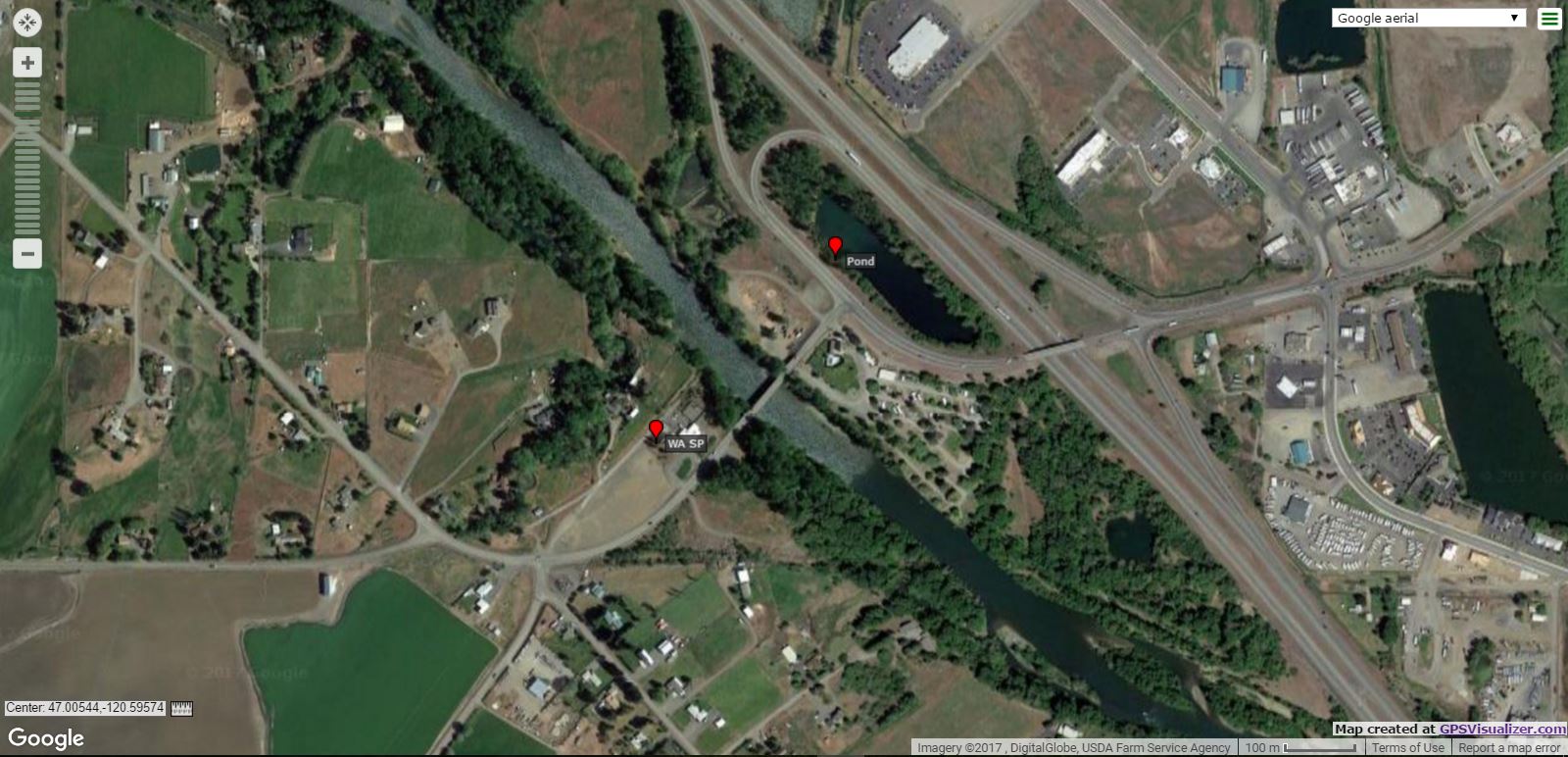
Site location map. Click to enlarge.
The sun was out everywhere within our driving radius and Rod had field plans ready for all possible directions. I was eager to make our first trip of the year over Snoqualmie Pass, so we agreed on a gridspace in the western outskirts of Ellensburg.  Our collecting activities were centered around the Thorp Highway bridge over the Yakima River. Despite the constant traffic noise from nearby Interstate 90, habitats were easy to access and the sunny Spring weather was a delight.

Looking upstream along the Yakima
River from the Thorp Hwy bridge. Note
swallow in lower left-hand corner.
A male Pardosa catching
some rays on a bridge post.
I collected spiders from the bridge guardrails (which hardly guarded anything, since they were only knee high!) as I walked from our parking spot on the south side of the river to my first cone tapping site. The Yakima River was really flowing fast -- several hundred cubic feet per second faster than average for that date, according to Bureau of Reclamation. I enjoyed watching northern rough-winged swallows (Stelgidopteryx serripennis) catching flying insects over the river.

Pond

Pondside ponderosas
My first cone tapping site was located on the edge of a pond created by the I-90 freeway interchange with US-97. It sounds like an awful spot to collect, but it was actually quite lovely. Ponderosa pine trees (Pinus ponderosa) lined the pond, each with an oval blanket of needles and hundreds of cones beneath.

Pholcophora americana
I tapped the usual 50 cones and collected a very unusual number of spiders: 76! That translates to more than 1.5 spiders per cone on average. Sixty-two of them (20 F, 16 M, and 26 J) were Pholcophora americana, the pholcid that Rod Crawford and I have dubbed a "pine cone spider" for its frequent presence in fallen ponderosa cones. Although I find the species at roughly 20% of sampling sites in eastern Washington, I have only once before found them at a similarly high density in cones. Additionally, they had the most annoying ability to so firmly secure themselves to the inside of my dry collecting vial that I had to take the time to "fish" each one out using a pine needle. Consequently, it took an excruciating 2.5 hrs to collect this 50-cone sample.

Other spiders tapped from this set of cones included a male of one of the tiny Neon species (Salticidae) as well as several juvenile Salticus scenicus (Salticidae). Although we frequently find S. scenicus in highly human-influenced environments, this is the first time I've found it present in the fallen cone microhabitat.

Cobbles at pond site
An Agroeca-like egg sac hanging
under a rock
The area was strewn with cobbles, so after tapping cones I decided to turn some rocks. Not too surprisingly, P. americana were plentiful among the five identifiable species I collected in that microhabitat. In many cases, they happened to be located near to other species' egg sacs. The most interesting egg sac I found was hanging from the underside of a rock like a boxer's speed bag. It resembles the egg sac of Agroeca (Liocranidae), but no Agroeca were present to confirm that.

Washington State Patrol

Fallen ponderosa cones next to WSP
Male Bassaniana utahensis in fore-
ground, female in background
Rod had spotted a pair of ponderosas on the grounds of the Washington State Patrol office, located just south of the bridge. This made an interesting second cone tapping site since, unlike the pond location, this one wasn't adjacent to a water body and was bone dry. I tapped 50 fallen cones and collected 10 spiders. Bassaniana utahensis (Thomisidae) was the most common identifiable species present, with 2 females and 1 male in the sample. Penultimate Phrurotimpus (Phrurolithidae) were also common. And, I tapped another juvenile S. scenicus from these cones!

In all I tapped 6 identifiable species from ponderosa cones near the Thorp Highway Bridge, three of them not taken from other microhabitats.

Read Rod's account of the day here.
Bassaniana utahensis in a crack in a wooden guardrail post
Morel (?) mushrooms were pushing up through the roadside leaf litter
Unfurling black cottonwood (Populus trichocarpa) leaves

Monday, April 10, 2017

9-Apr-2017 Phinney Ridge, Seattle, Washington

Site location map. Click to enlarge.
Now and then an opportunity to tap cones unexpectedly presents itself. That happened this past weekend on a visit to the Phinney Ridge neighborhood in northwestern Seattle. As luck would have it, I found two big western white pines (Pinus monticola) growing on the Phinney Community Center's grounds.  Under them lay cones and needle litter undisturbed by groundskeepers.  Woohoo! There were probably 200 fallen cones available to tap, but I stopped after 50 because those I tapped were so full of spiders that I ran out of time.

Cone source
How full of spiders were they?  Those 50 tapped cones yielded 47 spiders -- almost one spider per cone! The average is about one spider per five cones. The sample contained at least 8 species, 5 of which I could identify with certainty from adult specimens.

Cryptachaea blattea collection sites
The most numerous species in the lot was Cryptachaea blattea, a small introduced theridiid I've tapped from fallen cones in almost a dozen locations in the south Puget Sound urban corridor.  I collected a total of 14 of them from these 50 cones on Phinney Ridge: 2 females, 3 males and 9 juveniles.  Usually I only find a few of them at a time.
Fallen pine cones

Also present in good number were the native microspider Tachygyna vancouverana (7 females) and the introduced crab spider I've been tracking, Ozyptila praticola (2 females and 5 juveniles). Tenuiphantes tenuis and Tachygyna ursina rounded out the list of species represented by mature specimens.
Green Lake as viewed from Phinney Ridge. Pine trees on the right,
Cascade Range on the horizon.

Thursday, April 6, 2017

4-Apr-2017 Rapjohn Lake, Washington

Site location map. Click to enlarge.
Back in the field with Rod Crawford! Our last field trip together was in November, so this day was a welcome start to a new, combined field season. Rod selected Rapjohn Lake as our destination. Rapjohn is one of a string of small lakes located where a Pleistocene glacial drift plain meets the western foothills of Mount Rainier. Had the sky been clear, we would have had a grand view of the snow-clad volcano. The distance from lake to the peak is less than 30 miles, as the crow flies.
Moody skies over Rapjohn Lake
Douglas-firs lined the parking area
and game area access road.
Fallen Douglas-fir cones
Of course my first order of business was tapping fallen conifer cones. Seeing no western white pines in the area, I settled for Douglas-fir (Pseudotsuga menziesii). I tapped 97 cones and collected 9 spiders. The catch may have been small in number but it did provide the only specimens of Tachygyna vancouverana (Linyphidiidae) and Neottiura bimaculatum (Theridiidae) collected at the site. In addition, I tapped a female Scotinella (Phrurolithidae) from the cones that Rod has yet to identify. He sifted the same species from riparian poplar litter.

Salticus scenicus male
A female Pimoa altioculata in profile
Besides tapping cones, I also did a fair amount of grass sweeping and spider collecting from signs and structures. I found the familiar zebra jumping spider Salticus scenicus (Salticidae) hunting on the exterior of nearly every structure I examined, while individual Parasteatoda tepidariorum (Theridiidae) were in their cobwebs under nearly ever eave. The interior of the outhouse was both quite clean and well stocked with spiders. Among its inhabitants was a Pimoa altioculata (Pimoidae) female guarding her egg sac. The homeowners on either side of the public access were incredibly friendly and kindly invited me to collect spiders from the exteriors of their buildings. No doubt this increased the diversity of our catch!

You can read Rod's trip narrative here.

Fragrant apple blossoms.

Wednesday, April 5, 2017

2-Apr-2017 Lakewood and University Place, Washington

Site location map. Click to enlarge.
Sunshine and the promise of temps in the low 50s were the siren songs that brought me to the west side of the greater Tacoma conurbation. I was not disappointed.  In addition to the great weather, I found enough open cones at each site to take 100-cone samples.  A welcome combination!

Lakewood

Lakewood cone sources: black pines
(background), Scots pine (foreground)
Fallen black pine cone
I took my first two samples at Clover Park Technical College.  The planting strip along Steilacoom Blvd. was dominated by black pines (Pinus nigra) with a nice accumulation of needle litter and cones beneath.

Fallen Scots pine cones
An adjacent planting area featured several Scots pines (P. sylvestris), also with ample litter and cones beneath.

I tapped 100 fallen black pine cones and collected 13 spiders from 4 families, but Tachygyna ursina (Linyphiidae) was the only identifiable species. Next, I tapped 100 fallen Scots pine cones and collected just six tiny juvenile arachnids: 2 harvestmen and 4 Enoplognatha probably-ovata (Theridiidae).  Lots of cones tapped, but not much to show for it.  But I did enjoy the sunshine and the serenading of a white-crowned sparrow the whole while.

University Place

University Place cone source
Hundreds of western white pine cones
scattered between the trees
My final sampling site for the day was a small, boarded up building on Bridgeport Way with two massive western white pines (P. monticola) growing in front. Needle litter and hundreds of cones had accumulated beneath the trees on what was previously a gravel driveway and grassy yard.

Tapping 100 fallen cones I collected 34 spiders from 6 families.  Five species were identifiable: Tachygyna ursina and T. vancouverana, Xysticus cristatus (Thomisidae), Cryptachaea blattea (Theridiidae) and Tenuiphantes tenuis (Linyphiidae).  Six Philodromus sp. and nine Enoplognatha probably-thoracica were the most common juveniles in the sample.  All in all, it was a very typical urban sample from this part of the state.