Monday, April 24, 2017

21-April-2017 Thorp Highway Bridge, Ellensburg, Washington

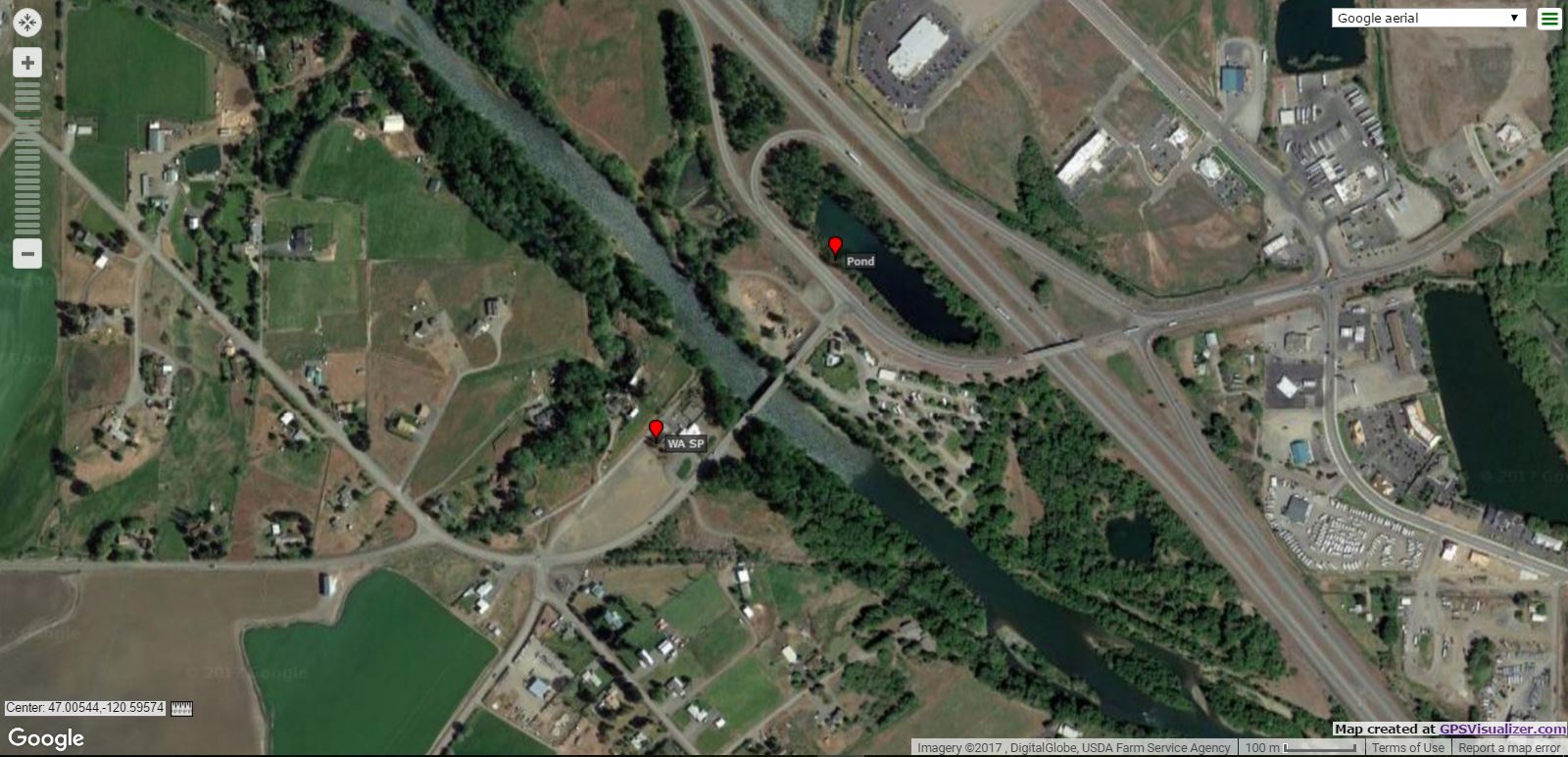
Site location map. Click to enlarge.
The sun was out everywhere within our driving radius and Rod had field plans ready for all possible directions. I was eager to make our first trip of the year over Snoqualmie Pass, so we agreed on a gridspace in the western outskirts of Ellensburg.  Our collecting activities were centered around the Thorp Highway bridge over the Yakima River. Despite the constant traffic noise from nearby Interstate 90, habitats were easy to access and the sunny Spring weather was a delight.

Looking upstream along the Yakima
River from the Thorp Hwy bridge. Note
swallow in lower left-hand corner.
A male Pardosa catching
some rays on a bridge post.
I collected spiders from the bridge guardrails (which hardly guarded anything, since they were only knee high!) as I walked from our parking spot on the south side of the river to my first cone tapping site. The Yakima River was really flowing fast -- several hundred cubic feet per second faster than average for that date, according to Bureau of Reclamation. I enjoyed watching northern rough-winged swallows (Stelgidopteryx serripennis) catching flying insects over the river.

Pond

Pondside ponderosas
My first cone tapping site was located on the edge of a pond created by the I-90 freeway interchange with US-97. It sounds like an awful spot to collect, but it was actually quite lovely. Ponderosa pine trees (Pinus ponderosa) lined the pond, each with an oval blanket of needles and hundreds of cones beneath.

Pholcophora americana
I tapped the usual 50 cones and collected a very unusual number of spiders: 76! That translates to more than 1.5 spiders per cone on average. Sixty-two of them (20 F, 16 M, and 26 J) were Pholcophora americana, the pholcid that Rod Crawford and I have dubbed a "pine cone spider" for its frequent presence in fallen ponderosa cones. Although I find the species at roughly 20% of sampling sites in eastern Washington, I have only once before found them at a similarly high density in cones. Additionally, they had the most annoying ability to so firmly secure themselves to the inside of my dry collecting vial that I had to take the time to "fish" each one out using a pine needle. Consequently, it took an excruciating 2.5 hrs to collect this 50-cone sample.

Other spiders tapped from this set of cones included a male of one of the tiny Neon species (Salticidae) as well as several juvenile Salticus scenicus (Salticidae). Although we frequently find S. scenicus in highly human-influenced environments, this is the first time I've found it present in the fallen cone microhabitat.

Cobbles at pond site
An Agroeca-like egg sac hanging
under a rock
The area was strewn with cobbles, so after tapping cones I decided to turn some rocks. Not too surprisingly, P. americana were plentiful among the five identifiable species I collected in that microhabitat. In many cases, they happened to be located near to other species' egg sacs. The most interesting egg sac I found was hanging from the underside of a rock like a boxer's speed bag. It resembles the egg sac of Agroeca (Liocranidae), but no Agroeca were present to confirm that.

Washington State Patrol

Fallen ponderosa cones next to WSP
Male Bassaniana utahensis in fore-
ground, female in background
Rod had spotted a pair of ponderosas on the grounds of the Washington State Patrol office, located just south of the bridge. This made an interesting second cone tapping site since, unlike the pond location, this one wasn't adjacent to a water body and was bone dry. I tapped 50 fallen cones and collected 10 spiders. Bassaniana utahensis (Thomisidae) was the most common identifiable species present, with 2 females and 1 male in the sample. Penultimate Phrurotimpus (Phrurolithidae) were also common. And, I tapped another juvenile S. scenicus from these cones!

In all I tapped 6 identifiable species from ponderosa cones near the Thorp Highway Bridge, three of them not taken from other microhabitats.

Read Rod's account of the day here.
Bassaniana utahensis in a crack in a wooden guardrail post
Morel (?) mushrooms were pushing up through the roadside leaf litter
Unfurling black cottonwood (Populus trichocarpa) leaves

Monday, April 10, 2017

9-Apr-2017 Phinney Ridge, Seattle, Washington

Site location map. Click to enlarge.
Now and then an opportunity to tap cones unexpectedly presents itself. That happened this past weekend on a visit to the Phinney Ridge neighborhood in northwestern Seattle. As luck would have it, I found two big western white pines (Pinus monticola) growing on the Phinney Community Center's grounds.  Under them lay cones and needle litter undisturbed by groundskeepers.  Woohoo! There were probably 200 fallen cones available to tap, but I stopped after 50 because those I tapped were so full of spiders that I ran out of time.

Cone source
How full of spiders were they?  Those 50 tapped cones yielded 47 spiders -- almost one spider per cone! The average is about one spider per five cones. The sample contained at least 8 species, 5 of which I could identify with certainty from adult specimens.

Cryptachaea blattea collection sites
The most numerous species in the lot was Cryptachaea blattea, a small introduced theridiid I've tapped from fallen cones in almost a dozen locations in the south Puget Sound urban corridor.  I collected a total of 14 of them from these 50 cones on Phinney Ridge: 2 females, 3 males and 9 juveniles.  Usually I only find a few of them at a time.
Fallen pine cones

Also present in good number were the native microspider Tachygyna vancouverana (7 females) and the introduced crab spider I've been tracking, Ozyptila praticola (2 females and 5 juveniles). Tenuiphantes tenuis and Tachygyna ursina rounded out the list of species represented by mature specimens.
Green Lake as viewed from Phinney Ridge. Pine trees on the right,
Cascade Range on the horizon.

Thursday, April 6, 2017

4-Apr-2017 Rapjohn Lake, Washington

Site location map. Click to enlarge.
Back in the field with Rod Crawford! Our last field trip together was in November, so this day was a welcome start to a new, combined field season. Rod selected Rapjohn Lake as our destination. Rapjohn is one of a string of small lakes located where a Pleistocene glacial drift plain meets the western foothills of Mount Rainier. Had the sky been clear, we would have had a grand view of the snow-clad volcano. The distance from lake to the peak is less than 30 miles, as the crow flies.
Moody skies over Rapjohn Lake
Douglas-firs lined the parking area
and game area access road.
Fallen Douglas-fir cones
Of course my first order of business was tapping fallen conifer cones. Seeing no western white pines in the area, I settled for Douglas-fir (Pseudotsuga menziesii). I tapped 97 cones and collected 9 spiders. The catch may have been small in number but it did provide the only specimens of Tachygyna vancouverana (Linyphidiidae) and Neottiura bimaculatum (Theridiidae) collected at the site. In addition, I tapped a female Scotinella (Phrurolithidae) from the cones that Rod has yet to identify. He sifted the same species from riparian poplar litter.

Salticus scenicus male
A female Pimoa altioculata in profile
Besides tapping cones, I also did a fair amount of grass sweeping and spider collecting from signs and structures. I found the familiar zebra jumping spider Salticus scenicus (Salticidae) hunting on the exterior of nearly every structure I examined, while individual Parasteatoda tepidariorum (Theridiidae) were in their cobwebs under nearly ever eave. The interior of the outhouse was both quite clean and well stocked with spiders. Among its inhabitants was a Pimoa altioculata (Pimoidae) female guarding her egg sac. The homeowners on either side of the public access were incredibly friendly and kindly invited me to collect spiders from the exteriors of their buildings. No doubt this increased the diversity of our catch!

You can read Rod's trip narrative here.

Fragrant apple blossoms.

Wednesday, April 5, 2017

2-Apr-2017 Lakewood and University Place, Washington

Site location map. Click to enlarge.
Sunshine and the promise of temps in the low 50s were the siren songs that brought me to the west side of the greater Tacoma conurbation. I was not disappointed.  In addition to the great weather, I found enough open cones at each site to take 100-cone samples.  A welcome combination!

Lakewood

Lakewood cone sources: black pines
(background), Scots pine (foreground)
Fallen black pine cone
I took my first two samples at Clover Park Technical College.  The planting strip along Steilacoom Blvd. was dominated by black pines (Pinus nigra) with a nice accumulation of needle litter and cones beneath.

Fallen Scots pine cones
An adjacent planting area featured several Scots pines (P. sylvestris), also with ample litter and cones beneath.

I tapped 100 fallen black pine cones and collected 13 spiders from 4 families, but Tachygyna ursina (Linyphiidae) was the only identifiable species. Next, I tapped 100 fallen Scots pine cones and collected just six tiny juvenile arachnids: 2 harvestmen and 4 Enoplognatha probably-ovata (Theridiidae).  Lots of cones tapped, but not much to show for it.  But I did enjoy the sunshine and the serenading of a white-crowned sparrow the whole while.

University Place

University Place cone source
Hundreds of western white pine cones
scattered between the trees
My final sampling site for the day was a small, boarded up building on Bridgeport Way with two massive western white pines (P. monticola) growing in front. Needle litter and hundreds of cones had accumulated beneath the trees on what was previously a gravel driveway and grassy yard.

Tapping 100 fallen cones I collected 34 spiders from 6 families.  Five species were identifiable: Tachygyna ursina and T. vancouverana, Xysticus cristatus (Thomisidae), Cryptachaea blattea (Theridiidae) and Tenuiphantes tenuis (Linyphiidae).  Six Philodromus sp. and nine Enoplognatha probably-thoracica were the most common juveniles in the sample.  All in all, it was a very typical urban sample from this part of the state.

Saturday, February 18, 2017

17-Feb-2017 Olympia & Lacey, Washington

Site location map. Click to enlarge.
The weather still wasn't dry enough for a full spidering trip with Rod Crawford, but it was just fine for tapping fallen conifer cones.  I decided to head to Thurston County to see what I could find.

I first tried looking for fallen pine cones in South Sound Center in Lacey, but had no luck. Like so many malls in western Washington, black pines (Pinus nigra) are a dominant feature in the landscaping there, but the needle litter and fallen cones had been removed by groundskeepers. In fact, a crew of groundskeepers was thus occupied while I was there.  Sadness.

Towering Jeffrey pine
Luckily I didn't have far to go to find my first cone source. I'd driven just a few hundred feet down Pacific Ave. when I spotted a magnificent Jeffrey pine (P. jeffreyi) towering over the realm. The native range of the Jeffrey pine is mainly the Sierra Nevada mountains in California, so it was a real surprise to find one growing in Olympia, Washington. But it was conveniently located at the edge of a parking lot in an area apparently untouched by groundskeepers, and it was gorgeous, so I was happy enough to come upon it.

My excitement faded, however, when I realized that this tree's fallen cones were poorly opened and few in number.  Still, I did collect a female Tachygyna ursina (Linyphiidae) from the 19 cones I tapped, a species not previously recorded in the gridspace. So at least there was that.

Double row of Douglas-firs
Fallen Douglas-fir cones
My second sampling site was located in St. Martin's Park in Lacey. A double row of Douglas-fir trees (Pseudotsuga menziesii) borders much of the park and had dropped a wealth of cones and needle litter undisturbed by groundskeepers. The scales on Douglas-fir cones usually close in damp weather, but not always entirely.  I was able to find plenty of cones with scales open far enough to harbor small spiders.

Grammonota kincaidi females
Tachygyna vancouverana
I tapped 50 cones and collected 14 spiders.  Nine of the 14 were Tachygyna vancouverana -- 8 females and 1 male. I often tap T. vancouverana from cones in western Washington, but usually it's just a few individuals per 50 cone set. However, I have tapped crowds of 16 or 17 of them a few times, so finding 9 was unusual but not exceptional.  I also collected 2 female Grammonota kincaidi from this batch of cones, another linyphiid that I've only tapped from fallen cones once before.

Wednesday, February 15, 2017

12-Feb-2017 Ferndale & Blaine, Washington

Site location map. Click to enlarge.
A lovely break in the winter weather gave me an opportunity to return to Whatcom County to continue my search for the European crab spider Ozyptila practicola (Thomisidae).  My destinations: Ferndale and Blaine.

Black pines bordering the Ferndale
Park and Ride lot.
The Ferndale Park and Ride lot was my first site.  A row of black pines (Pinus nigra) growing along the eastern property line had dropped plenty of cones. Most of them were poorly opened, but I managed to find 50 that were open enough for O. praticola, if present, to squeeze into. All I tapped from those 50 cones were three juvenile spiders: a linyphiid, a dictynid and a theridiid that was probably Platnickia tincta. Not a very auspicious start to my sampling day.

Mt Baker, as seen from the Haggen
parking lot
Heading into town I spotted another row of black pines, this time bordering the Haggen grocery store parking lot.  Although the cones were more open than at the previous site, I didn't find even one spider in the 50 that I tapped.  At least I had a nice view of Mt. Baker while getting skunked!

Black pines bordering picnic area
next to the Nooksack River
My third and final location in Ferndale was a pleasant picnic area overlooking the Nooksack River. The cone source was again a line of black pine trees bordering the parking area. The cones here were generally well opened, and lay on a thick, sumptuous bed of needle litter.

The fallen cone microhabitat
I tapped 100 cones and collected 15 spiders.  Eight of them were juvenile Enoplognatha probably-ovata (Linyphiidae).  Also present were a pair of penultimate male Xysticus probably-cristatus and another pair of Philodromus juveniles.  The only identifiable species, and perhaps also the only native species present, was Tachygyna ursina.

Black pines on C St.
in Blaine
The last two sampling sites of the day were in the border town of Blaine. The first site consisted of three black pines in a parking lot.  I found 91 cones to tap, all laying on thick needle litter.

Dictynid female from C St. cones
turns out to be Lathys humilis
Those 91 cones produced 10 spiders, the most interesting of which was a female dictynid that I haven't yet identified.  I also tapped several female T. ursina and T. vancouverana from these cones, as well as juveniles from three of the more common introduced species. Update: The dictynid was Lathys humilis. Additionally, a spider I identified as T. ursina turned out to be the undescribed T. sp. #4.

Black pines at Blaine post office
My final cone source for the day was a row of black pine trees growing along the fence line of Blaine's main post office.  Tapping 50 cones, I collected 11 spiders and 4 to 5 species.  The only mature spider in the set was a male Erigone (Linyphiidae).  The rest were juvenile dictynids, Xysticus probably-cristatus and E. probably-ovata.

The mix of spiders I tapped from pine cones in Ferndale and Blaine was pretty typical of what I find in the urban Interstate 5 corridor.  But I was frankly surprised that I didn't find any O. praticola in cones in either city.  This is especially true of Blaine, which is only a few miles from locations in British Columbia where O. praticola has been collected.

Ozyptila praticola sampling sites in WA and B.C. Blue or purple: Confirmed with
adult specimen; Yellow: Juvenile likely O. praticola; Red: No O. praticola
found. Note: B.C. records via Bennett et. al 2014

Tuesday, November 8, 2016

6-Nov-2016 Bellingham, Washington

Site location map. Click to enlarge.
I was all set to drive to Olympia to look for the introduced crab spider Ozyptila praticola, happy at the thought that traffic on southbound Interstate 5 should be light since it was a Sunday morning. But right before leaving, just to be on the safe side, I decided to check the traffic conditions. Good thing I did! An accident in Tacoma was blocking all but one lane. But northbound traffic was still moving smoothly, so Bellingham became my last-minute destination for the day.

I hadn't found any O. praticola on a recent trip to Burlington, the closest urban center south of Bellingham, but I still thought it likely to be present in Bellingham and the northwestern corner of the state, at least along the I-5 corridor.  This is because it's been collected just over the Canadian border near Vancouver, British Columbia (see map at end of post).  So although Bellingham wasn't my original destination for the day, I didn't mind traffic conditions diverting me there.

Bellingham has no shortage of pines, I found, but there was a distinct shortage of fallen cones beneath them due to groundskeeping practices. However, after searching diligently I eventually found two collection sites, each consisting of one western white pine (Pinus monticola) with fallen cones beneath.

Lincoln Street Underpass

Site on Lincoln Street near
I-5 underpass. Pine on left.
Lincoln St. cones were barely open
A pine tree dominated the space between the sidewalk and someone's privacy fence, and had dropped numerous cones on a thick bed of needle litter with miscellaneous bits of trash mixed in. Most of the cones were only partially open and quite wet from recent rain. And in fact my net got wetter with each cone I tapped, to the extent that I was ruing the fact that I'd left my spare net at home.  But the result was worth it: I tapped 66 spiders and 6 identifiable species from those 50 cones!

Male Centromerita bicolor tapped
from a pine cone
Tachygyna vancouverana males
For the most part, the sample composition was typical of what I've found previously in Washington's I-5 corridor: lots of juvenile Philodromus and Enophlognatha, a few Tegenaria and some adult Tenuiphantes tenuis and Tachygyna vancouverana.  What was unusual, however, was that T. vancouverana made up over a third of the sample. They were everywhere, both males (7) and females (24). In addition, this sample contained a novelty in terms of cone tapping: Centromerita bicolor, another introduced linyphiid.  It was first found in Washington in 1975 by Rod Crawford, in Seattle.  He collected it again in 1988 in Bellingham, just a mile or so from my Lincoln Street site.  Apparently it's naturalized in Bellingham.  And finally, I tapped from these cones one juvenile Ozyptila with praticola coloring and patterning.

James Street at Whatcom Creek

My James St. pine cone
source
The James St. fallen cone
microhabitat
My second site was only about a quarter of a mile (0.4 km) to the northwest of the first site, as the crow flies.  But with daylight rapidly fading (sunset at 4:40 p.m.!), I was just happy to have found another cone source.  It was another western white pine, this time standing in the grassy area between Whatcom Creek and a parking lot.  A tangle of Himalayan blackberry (Rubus armeniacus) growing at its base had recently been cut back, making the fallen pine cones beneath accessible to me.  I often grumble about groundskeepers, but in this case they'd inadvertently done me a good turn.

Juvenile Ozyptila from James St. site
As at the first site, the scales on the cones here were poorly opened, yet they were open far enough for many spiders to have entered.  I was only able to find 25 cones to tap, but they delivered 14 spiders and one identifiable species, Phrurotimpus borealis. The rest of the sample was very much like a subset of the Lincoln St. sample including, once again, one juvenile Ozyptila with praticola coloring and patterning. As the saying goes, "so close and yet so far".

Ozyptila praticola collection sites in WA and B.C.
Blue: Confirmed with adult specimen; Yellow: Juvenile possible O. praticola;
Red: No O. praticola found. Note: B.C. records via Bennett et. al 2014

The banks of Whatcom Creek are choked with invasive Himalayan
blackberry, which incidentally originated in Armenia and Iran, not the Himalayas.