Thursday, May 14, 2015

12-May-2010 South Whidbey Island, Washington

Site location (click to enlarge)
Nothing like a ferry ride to make a field day extra exciting, especially when the destination is an island.  And then when you unexpectedly find tappable pine cones at your destination, well, it doesn't get much better than that.

Sample site
Earlier in the year, Rod had helped a local homeowner identify a moth, and in return she kindly gave us permission to collect spiders on her family's property.  When we arrived, I was delighted to discover a stand of western white pine (Pinus monticola) growing just steps from the road.

The fallen cone microhabitat
The cones were lying in a wide variety of situations, including on bare sand, on grass and other herbs, and on needle litter both with and without adjacent understory vegetation.  It was hard to take a representative photo.

Tapping 60 cones, I collected 48 spiders and 14 species from 7 families.  Compared to my eastern Washington cone samples, where I'm lucky to collect 6 species per site, this sample was exceedingly rich.  Being in Puget Sound, I suppose it wasn't too surprising that 3 of the species were introduced.

Interestingly, the most numerous species in my cone sample was Neriene litigiosa (Linyphiidae).  Commonly called the Sierra dome weaver, this species is most often collected from vegetation or aerial webs, but also pitfall traps.  So far, this site remains the only place I've collected it from cones.

Wednesday, May 13, 2015

15-18 Oct 2011 Klickitat County Expedition Part 4, Washington


Mt. Adams (L) and Blockhouse Butte (R)
Continuing the story from Parts 1, 2, and 3:  The last major sampling site of our expedition was located near Blockhouse Creek, a tributary to Klickitat River with headwaters near Goldendale.  This was by far the richest site of the expedition, in terms of cone spiders.

A fascinating locale, the most obvious features in the landscape were Mt. Adams in the distance, a partially mined cinder cone called Blockhouse Butte closer by, and a grass-covered lava field in the pasture.  

Ponderosas in Blockhouse Creek
cow pasture
Cone & patty blend
Another major feature of the site was cow patties.  Lots and lots of cow patties, especially around the ponderosa pine (Pinus ponderosa) trees where the fallen cone microhabitat was.  The patties seemed to be supporting a robust population of tiny flies as well as fungi.

Fungi on manure
View of a hatched spider egg
inside egg sac on cone scale
I tapped 107 cones and collected a stunning 118 spiders and 12 species.  The most numerous were Dictyna calcarata (Dictynidae), represented in my sample by 8 females and 55 juveniles.  Interestingly, we didn't collect any other specimens of that species in any other microhabitat at Blockhouse Creek, and I've never tapped it from a cone at any other site before or since.  In Washington, it has most frequently been collected in or on buildings.

Tail feather from red-tailed hawk
(Buteo jamaicensis)
I also collected 10 female Meioneta fillmorana (Linyphiidae) from the tapped cones.  Although this is the 3rd-most common species of spider found in cones in eastern Washington, we've never before or since found it in cones at such a high density.  Three females of the same undescribed species of Disembolus (Linyphiidae) I found at our previous site, Outlet Creek, rounded out the list of notables.  The high level of spider diversity and density we observed in these manure-strewn cones made me wonder whether the manure might have spiked the spiders' food chain with nutrients.  It's an interesting thought.

Site locations (click to enlarge)
It was time to start working our way back to Seattle.  The return trip took us back through Goldendale, giving me the opportunity to tap a few dozen more cones on the grounds of the Goldendale Observatory.  In all, I tapped 101 ponderosa cones there and collected 18 spiders and 4 species.  Among them was a male of an undescribed species of Agyneta (Linyphiidae) found only once before in Washington, in 1996.  It would subsequently be named A. crawfordi by Nadine Dupérré, in honor of none other than Rod Crawford.

Neobisiid pseudoscorpion (photographed
at Goldendale Observatory)
With daylight waning, we made one final, brief stop back near Satus Pass at Brooks Memorial State Park.  I tapped only 2 juvenile spiders from 25 ponderosa cones, but also 14 mature pseudoscorpions from the family Neobisiidae. 

Noticeably short in numbers and occurrence on this expedition were Euryopis formosa (Theridiidae).  After analyzing 6 years of collection data from eastern Washington, Rod Crawford and I have dubbed E. formosa a "pine cone spider" because we've found it to be the most abundant species collected from cones (27% of specimens) as well as the most frequently occurring (49% of collection sites).  Yet on the this expedition, after tapping a total of 802 ponderosa cones from 9 sampling sites and collecting a total of 333 spiders, we turned up only one E. formosa. It just goes to show how misleading it could be if we tried to draw any broad conclusions from a collection period of limited duration like this 4 day expedition.

For a non-cone-centric view of "The Great Klickitat Expedition", read Rod's account here!

15-18 Oct 2011 Klickitat County Expedition Part 3, Washington

Morning sun shining through fog near
Goldendale Observatory
Continuing the story from Part 1 and Part 2:  Knowing that Rod would need to wait for the morning dew to dry before sampling herbs, I made an early stop at Goldendale Observatory before heading back to Badger Gulch.  My second visit to the observatory's forest was just as magical as the first, thanks in no small part to the morning fog.

Returning to Badger Gulch, I was pleased to learn that Rod's night had been more peaceful than the previous, and that dew had been the worst of his atmospheric concerns.  Dew we can handle!


Mouth of Badger Gulch, Day 2
Now that is a lot of cones!
Being full of morning energy, I hiked into the mouth of Badger Gulch, which was across the road and uphill from my sampling site of the day before.  Smooth sumac (Rhus glabra) in brilliant scarlet foliage and Garry oaks (Quercus garryana) were the gatekeepers here, but I quickly found dense accumulations of cones under a few giant ponderosa pines (Pinus ponderosa).  I tapped 17 spiders and 4 species from 90 cones.  One specimen was a male Dipoena daltoni (Theridiidae), exceedingly rare in the state.

Klickitat Co. site locations
(click to enlarge)
Pine cone microhabitat (and acorns) at
Klickitat Trail site
While Badger Gulch was part of the first major drainage system east of Goldendale (Rock Creek), our next stop was Klickitat Trail along the first major drainage system to Goldendale's west, the Klickitat River.  I found and tapped 52 fallen ponderosa cones amid the Garry oak leaf litter, and collected 34 spiders and 6 species.  Half of the specimens were Pholcophora americana (Pholcidae), the 2nd most numerous and 2nd most frequently occurring spider in eastern Washington ponderosa cones.

Zipping by the ponderosas on the
drive to Outlet Creek Campground
Autumn beauty was a fine distraction
Outlet Creek Campground, located on one of the headwaters of the Klickitat River, would be our final stop for the day.  As we made the long drive into the area, I realized the folly of my decision to spend another night in a hotel in Goldendale; I'd have to drive this beautiful but tiring route again this evening, then yet again the following morning to pick up Rod, and then still again as we headed downstream towards our final sampling site and then home.  But the die was cast, I just tried to enjoy the scenery and ignore the driving fatigue.

Stumps and slash: reminders
that this is a working forest
Although the ponderosas near the campground had been selectively cut, I still managed to find and tap 136 cones for 28 spiders and 6 species.  By far the most interesting were the male and female Disembolus (Linyphiidae) from an undescribed species rare in the state.

Before heading downstream to our next site, we refreshed our eyeballs with this gorgeous view of  Mt. Adams and the countryside.


Tuesday, May 12, 2015

15-18 Oct 2011, Klickitat County Expedition Part 2, Washington

Klickitat Co. site locations (click to enlarge)
Continuing the story from Part 1:  We decided that the sensible thing to do was to drive directly to Goldendale, find a laundromat, and dry Rod's sodden sleeping bag.

Left behind at the laundromat
Since dryers don't dry any faster with two people staring at them, I left Rod to his book at the laundromat while I headed a few miles north to tap some ponderosa pine (Pinus ponderosa) cones on the grounds of the nearby Goldendale Observatory.  I tapped cones in this enchanting pine-oak woodland a total of three times during our expedition, so I'll describe my cumulative catch later.

Line of riparian pines in the steppe
west of Bickleton
Go back to sleep!
After retrieving Rod and his now-dry sleeping bag from the laundromat, we headed to our eastern-most site in the county, a spot just west of Bickleton.  I collected 15 spiders and 6 species from 117 ponderosa pine cones.  The most interesting catch was an undescribed species of Disembolus (Linyphiidae) which Rod also sifted from hawthorn (Crataegus douglasii) litter. In addition to spiders, harvestmen and pseudoscorpions, these cones were loaded with ladybird beetles and sleepy yellowjackets.

Cleveland Cemetery
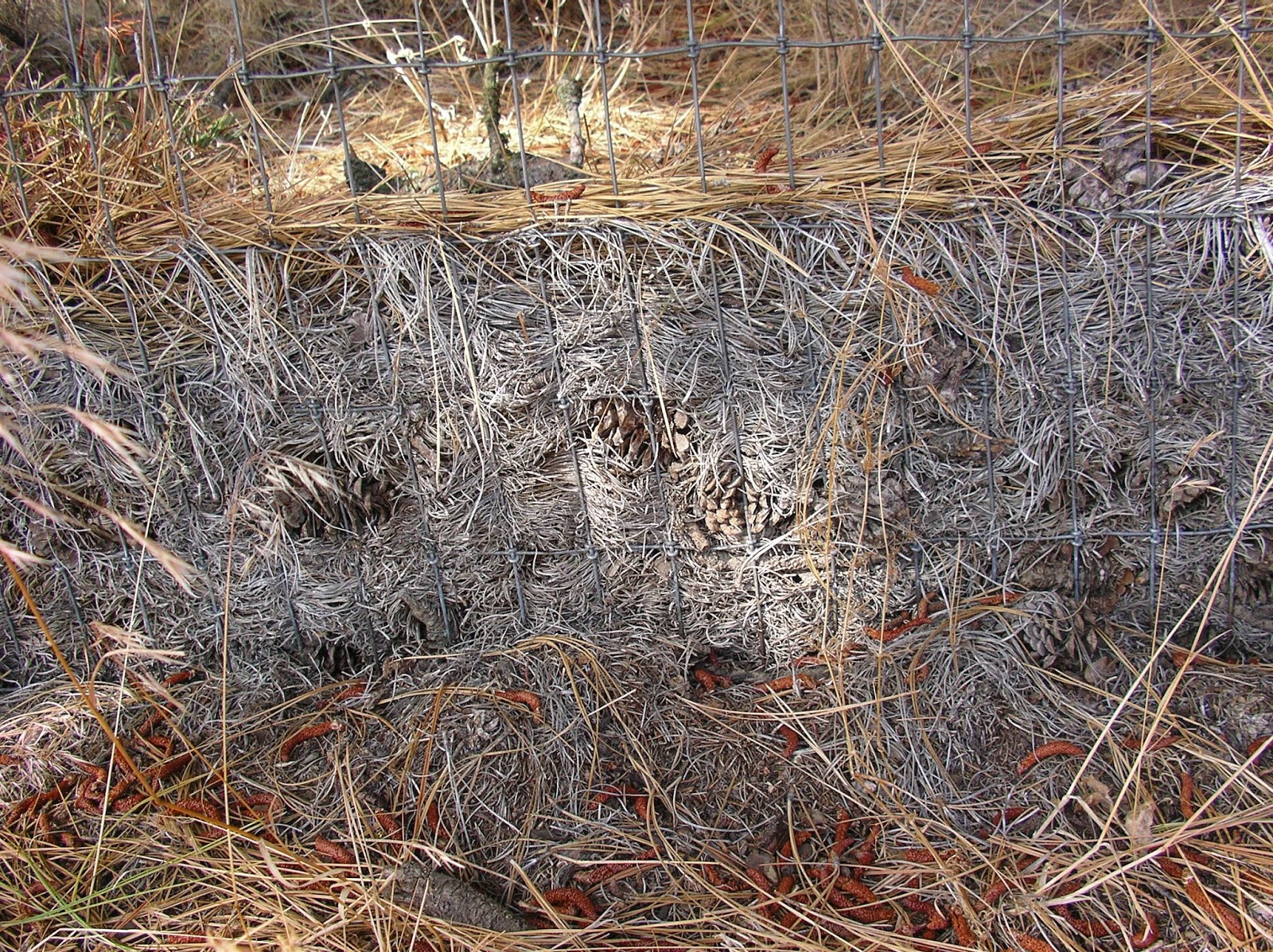
Layer upon layer of cones and
needles accumulated against this fence
Our next stop, Cleveland Cemetery, was just a few miles to the southwest.  Seventy-two tapped cones here produced 27 spiders and 3 species.  Almost half of the spiders were juvenile Anyphaena (Anyphaenidae), while two of the species were repeat customers from the site west of Bickleton: Meioneta fillmorana (Linyphiidae), which is the third-most common species found in fallen ponderosa cones in eastern Washington, and Poecilochroa columbiana (Gnaphosidae).  From here we proceeded on to the Cleveland rodeo grounds, but I found no tappable cones there.  Rod was understandably pleased with his catch, however.

Pines in hairpin turn in road
at Mouth of Badger Gulch
Onward west to Goldendale!
Our final stop of the day was at the mouth of Badger Gulch, where Rod was camping for the night.  I tapped 50 cones under a few ponderosas growing inside a hairpin turn in Bickleton Highway and collected 8 spiders from 3 species.  This was really the day for Meioneta fillmorana, because I collected 2 more females of the species here.

Since I had a hotel bed waiting for me back in Goldendale, I bid Rod a good (and dry!) night and headed into the sunset.

The next morning, Mt. Adams hung like an apparition over Goldendale.

15-18 Oct 2011, Klickitat County Expedition Part 1, Washington

Vernita Rest Area location
Since we'd had such a successful field trip to the Okanogan Highlands earlier in the summer, Rod and I decided to embark on an even more extensive expedition to Benton and Klickitat counties.  It would be my last spider collecting hurrah before moving to Massachusetts.

Vernita Rest Area shaded by planted
ponderosa pines

We headed first for Richland in Benton Co., where Rod hoped to complete a partial sample taken years before.  The Richland site didn't hold much promise for pine cone tapping, but on our way there we stumbled upon a planted ponderosa pine (Pinus ponderosa) grove at the Vernita Rest Area in Mattawa.

Egg sacs like this were common
on cone scales at Vernita
I already knew from tapping cones at Ginkgo Petrified Forest that spiders utilize the cones of ponderosas planted in the Columbia plateau shrublands.  And sure enough, the cones at Vernita were busy with spiders.  I tapped 52 cones and collected a whopping 66 spiders and 6 species.  Juvenile Philodromus (Philodromidae) crab spiders, a few identifiable as P. spectabilis, made up over half of the specimen count.  I wonder whether these juveniles had emerged from the egg sacs that I found on many cone scales?

Klickitat County locations (click to enlarge)
The remainder of our sampling sites were more or less centered around Goldendale in Klickitat County.  Our first stop was Pine Springs Resort near Satus Pass on Rte 97, where I spent the night in a tiny cabin and Rod pitched his tent under the trees in front.  I woke the following morning to find Rod and his tent both thoroughly soaked from rain.  Apparently I slept very soundly, because I never heard poor deluged Rod pounding on my door during the midnight downpour!  Good thing he had a car key, and could sleep there.

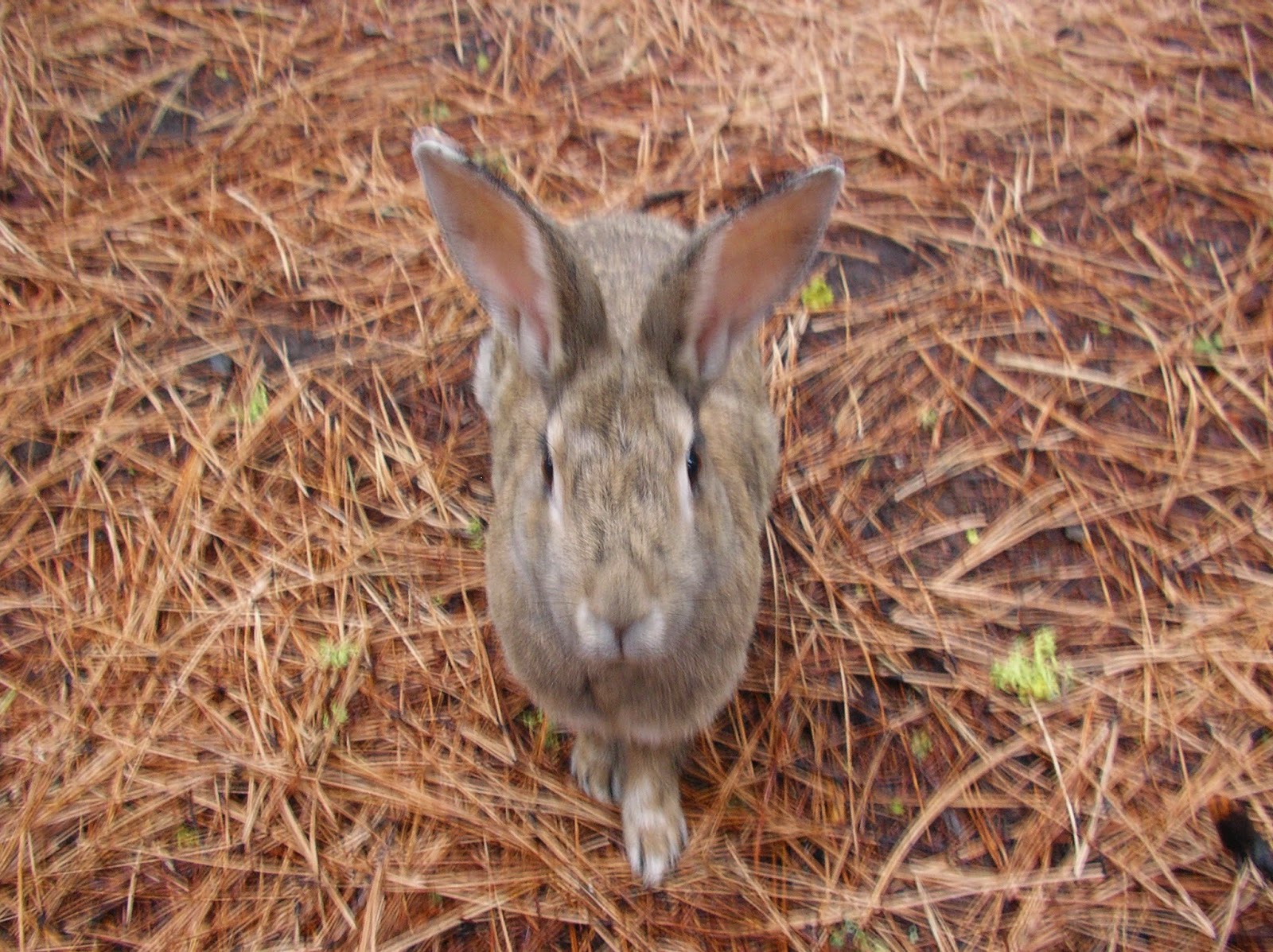
Yet another big friendly bunny!
Big friendly bunny
The next morning, while Rod warmed up in my cabin, I headed into the nearby oak and pine woods, thinking I could squeeze in a quick cone sample before we headed into town.  I found plenty of ponderosa pines, but no cones.  As we packed the car, several very large domesticated rabbits hopped over to check out our food-vending potential.  They had excavated warrens under the cabins.

Monday, May 11, 2015

20-Aug-2011 Watson Lakes Trail, Washington

Site location (click to enlarge)
Joining Rod Crawford and friends on a spider collecting trip in a subalpine meadow on Anderson Butte in the North Cascades, I didn't expect to be tapping cones this day.  But the Watson Lakes Trail leading to our destination climbed through an old growth forest of Pacific silver fir (Abies amabilis) and mountain hemlock (Tsuga mertensiana).  The hemlock had dropped cones alongside the trail, and naturally I couldn't resist tapping them!


A flash was required to get a sharp photo of
fallen hemlock cones in the dense, dark forest
The 36 tiny, inch-long cones that I tapped harbored some even tinier arachnids; 3 juvenile linyphiids from the microspider sub-family Erigoninae, and 2 juvenile harvestmen.  Add another species of conifer to the cone spider list!

So far, I've found spiders in the fallen cones of the following conifer species:
Ponderosa pine (Pinus ponderosa)
Western white pine (P. monticola)
Eastern white pine (P. strobus)
Red pine (P. resinosa)
Lodgepole pine (P. contorta var. latifolia)
Coulter pine (P. coulteri)
Douglas-fir (Pseudotsuga menziesii)
Mountain hemlock (Tsuga mertensiana)

Be sure to check out Rod's narrative and photo album from Watson Lakes Trail!

Marsh marigolds (Caltha leptosepala) emerging from the snow in subalpine meadow
above the fir-hemlock forest.  Mt. Baker was stunning in the distance.

Saturday, May 9, 2015

18-Aug-2011 South Of Mt. Adams, Washington

Site locations (click to enlarge)
On my way home from visiting friends in Oregon, I stopped at two southern Washington sites to tap ponderosa pine (Pinus ponderosa) cones.  My first site, the remote Pineway Trailhead, was located literally across the street from the Yakima Reservation.  The drive to the trailhead offered some spectacular views of Mt. Adams, while the trail head itself offered a humorous view of cattle coming off the trail, the only "hikers" I saw.

Pineway trailhead
Luckily cones fell on both sides
of the boundary trees
The ponderosas growing near the road on the reservation had recently been nearly clearcut, while the forest on the US Forest Service side of the road remained intact.  Nevertheless, the cones were more abundant on the reservation side.  Although the reservation boundary was blanketed with "no trespassing" signs, I was able to find plenty of cones to tap on the US side of the signed trees.

Agelenid web on ponderosa
cone at Pineway trailhead
She was as surprised to see me
as I was her!
I collected 16 spiders and 2 species from 57 tapped cones, including another female from the same undescribed species of Dictyna (Dictynidae) that I'd tapped earlier in the summer from cones at Thunder Lake and Reecer Creek Road.  The other identifiable spider was a female wolf spider Pardosa mackenziana (Lycosidae).  It's not especially unusual to find lycosid juveniles and lycosid exuviae in cones, but adult lycosids are a rarity, despite their ground-dwelling habits. 

Fallen cone microhabitat
in ditch north of Husum
Site north of Husum
My second site was located in a steeply-sided roadside ditch at the intersection of Rte 141 and a side road just north of Husum.  Although I could only find 27 cones to tap, they yielded an astonishing 30 spiders and 2 species.

Closeup of Novalena sp
Novalena sp. and exuvium
Juvenile linyphiids were the most numerous (10), while the 2 female Poecilochroa montana (Gnaphosidae) won the prize for beauty.  But the spider that I got the best photos of was a juvenile Novalena sp. (Agelenidae) and its exuvium.

Mt Adams