Saturday, July 25, 2015

23-Jul-2015 Glacier View Trail, Washington

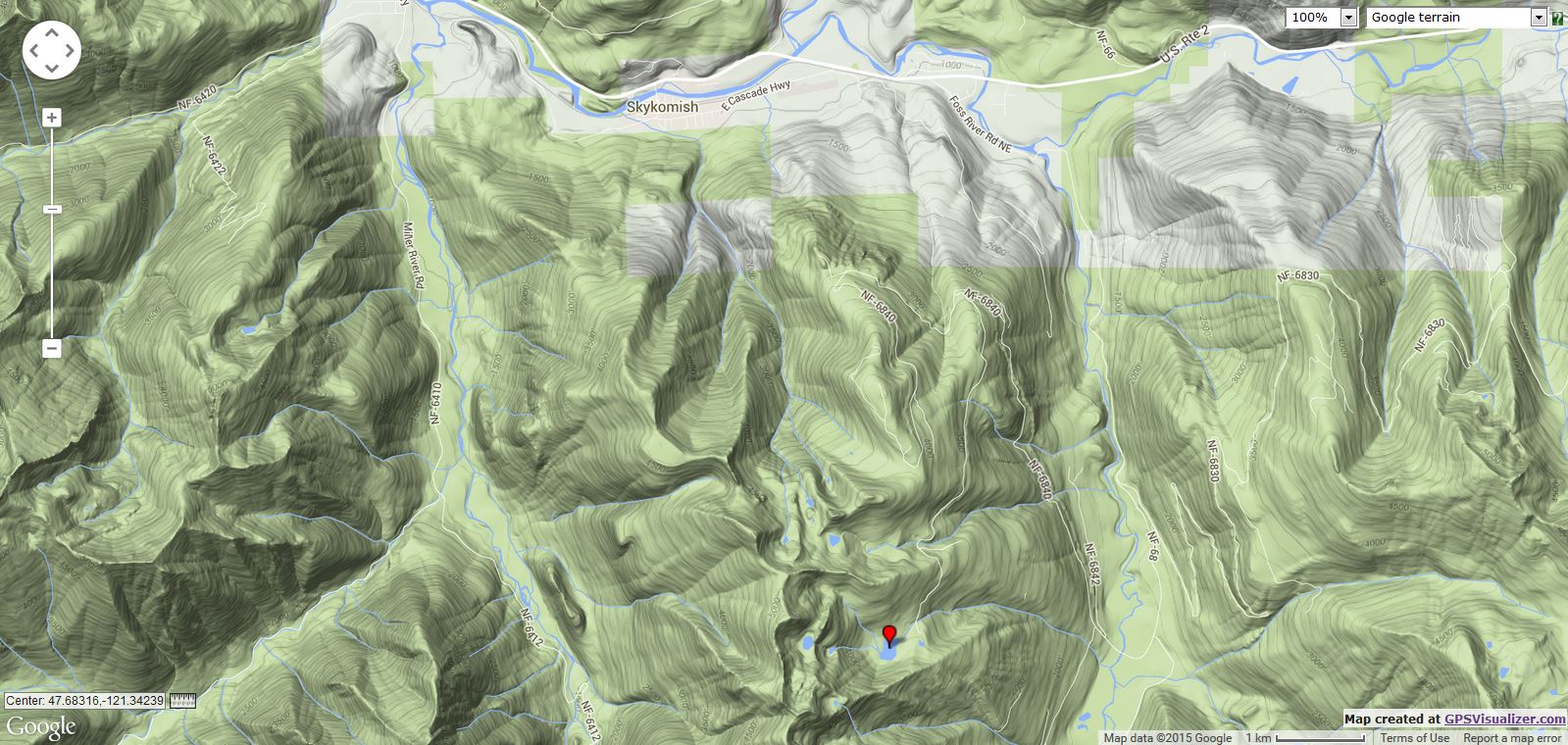
Location of Glacier View summit
(click to enlarge)
Even in the wilderness there
is paperwork!
I love Mt. Rainier, and so I jumped at Rod Crawford's suggestion that we might collect along the upper reaches of Glacier View Trail #267 located in the volcano's western foothills.  The long drive there ended in an 8.3 mile stretch of forest road that was barely passable in our city car, but we made it without incident and were treated to the sight of an evening grosbeak (Coccothraustes vespertinus) in the parking area as we prepared for the trail. 

A low cloud bank hid Mt. Rainier.
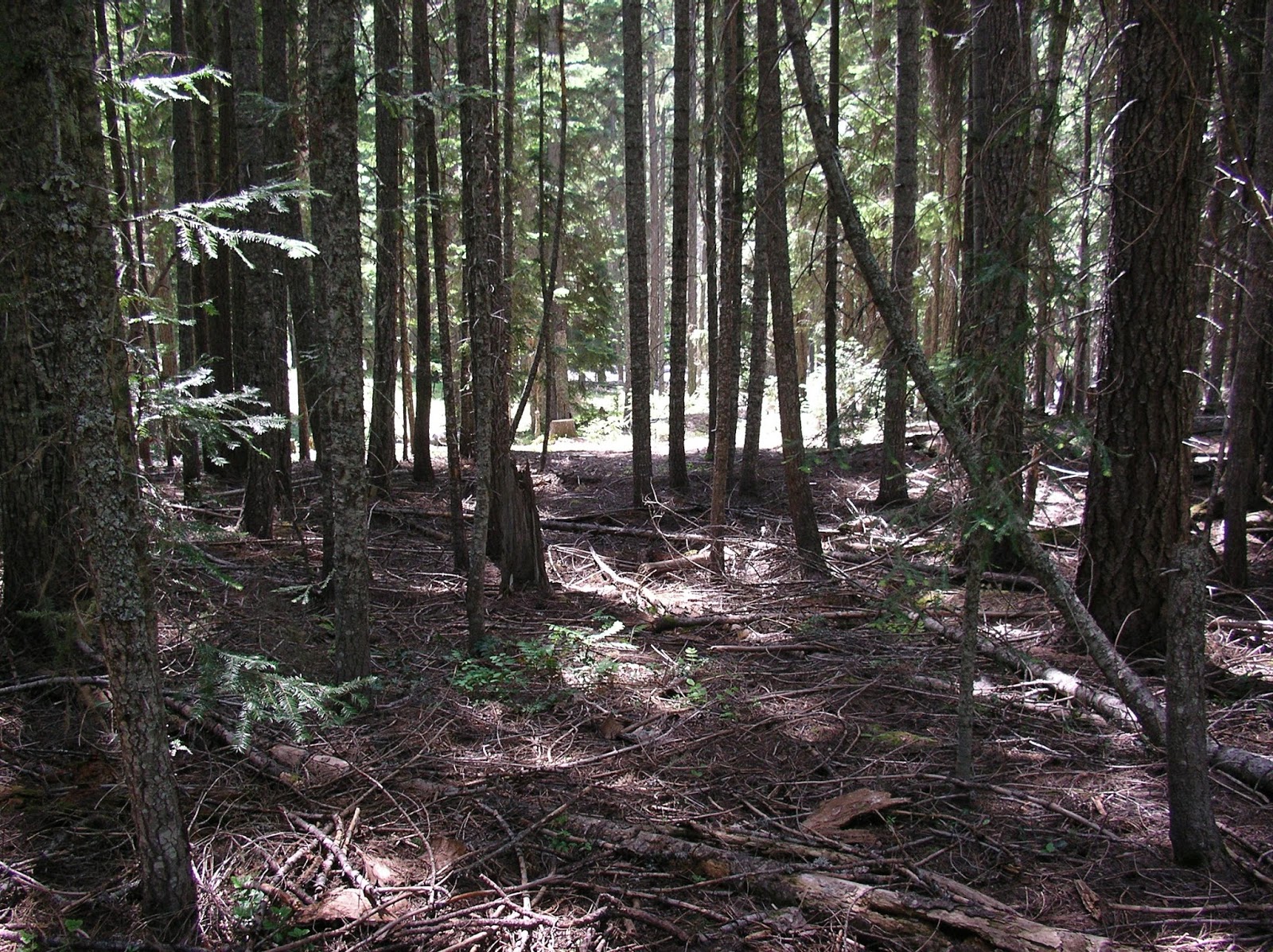
Parting ways with Rod half way up the trail, Marie Rose and I continued hiking to the Glacier View summit while Rod started his collecting.  Low clouds initially blocked our view of the volcano mount, so we too began sampling, first conifer foliage along the summit trail itself, then mountain hemlock (Tsuga mertensiana) cones a bit below the summit trail's split from the main trail.

Cone sampling site
Lots of mountain hemlock cones
Mountain hemlock cones were abundant in this forest, so I had the luxury of deciding to sample at a spot that also had a nice log to sit on.  No reason not to be comfortable when the opportunity presents itself!  I tapped 50 fallen western hemlock cones and collected 3 spiders and 1 species, Lepthyphantes rainieri (Linyphiidae).  Rod also found L. rainieri to be common in dead wood and litter at his site.  I'd tapped it from cones once before, on the opposite side of Mt. Rainier.

Mt Rainier was out!
A few Indian paintbrushes were still blooming
Just as I finished the cone sample, Marie Rose returned from a second jaunt up to the Glacier View summit to report excitedly that now the mountain was out.  We returned to a spectacular "in your face" view of Mt. Rainier as well as more distant views of Mt. Adams and Mt. Saint Helens and a weather front seemingly heading our way.  After much ogling and photo snapping, we headed back into the forest to sweep meadow herbs along our return hike.  The trailside meadows were fairly dried out, but Indian paintbrush (Castilleja sp.), harebells (Campanula sp.) and asters were still in bloom.

Last of the lilies
Fuzzy coyote scat
Avalanche-lilies (Erythronium montanum) carpeted the trailside in several places.  Unfortunately for us they had already gone to seed, but they must have been a glorious sight a month ago.  A coyote had left its calling card on the trail in the form of scat.  Furry creatures were clearly on its menu.

Read Rod's account of the day here.


Juniper (Juniperus) growing along the Glacier View summit trail

Monday, July 20, 2015

17-Jul-2015 Evans Lake, Washington

Site location (click to enlarge)
On this trip Rod Crawford and I enjoyed the company of Markku Savela, an avid photographer of lepidoptera and other life forms in Finland and beyond.  Markku arrived with a high-clearance vehicle in addition to his photographic equipment, so I was able to sit back and enjoy the sights as he negotiated the forest roads to Evans Lake.

Evans Lake
An American dipper at Evans Lake
Most subalpine lakes in Washington are only accessible via a solid hike, but not this one.  If you can figure out which unmarked forest road is the correct one and spot the poorly marked trailhead, a few minutes amble down a gentle path brings you to Evans Lake.  Upon reaching the lake the first thing I spotted was the unique songbird American dipper (Cinclus mexicanus), which swims under water.  The opposite end of the lake was teeming with mayflies busily mating and laying eggs on lake surface.  Ripe blueberries and huckleberries (Vaccinium sp.) and overripe salmonberries (Rubus spectabilis) were available in profusion.

Mountain hemlock (Tsuga mertensiana)
cone microhabitat at Lake Evans
Cones were about 2 inches
(5-6 cm) long
There were no pines in the surrounding forest, but plenty of mountain hemlock (Tsuga mertensiana). To paraphrase an old saying, when in a hemlock forest, tap hemlock cones.  This was only the second time I tapped T. mertensiana cones, the first being in August 2011 along the Watson Lakes Trail.  Those cones yielded a few immature linyphiids and harvestmen and served as the first record of spiders in T. mertensiana cones, but didn't contribute to the species list for that sampling location.  My Lake Evans cone sample was more interesting.

Coreorgonal petulcus © Rod Crawford
I collected 6 spiders and 2 species from 50 tapped* T. mertensiana cones as well as 1 harvestman.  A female Agyneta (Linyphiidae) awaits species determination, but Rod was immediately able to identify the other mature specimen as a teneral male Coreorgonal petulcus (Linyphiidae).  I tapped C. petulcus once before from western white pine (Pinus monticola) cones in the subalpine zone, in August 2010 on Suntop Mountain. 

A police car moth (Gnophaela vermiculata)
nectaring on Angelica sp.
Tiny rainbow trout in inlet stream
*A note on tapping mountain hemlock cones:  Mountain hemlock cones are too small to be tapped like pine cones (My pine cone tapping method is described here).  For the Lake Evans cones, "tapping" consisted of a combination of holding each cone upside-down or sideways over my net and tapping it with a small stick, and/or flicking it with my fingers, and then gently twisting it in an attempt to remove the scales.  Scales readily fell from the axes of older, but not newer, cones.

A green comma (Polygonia faunus)
looking cryptic on charcoal...
...until it opened its wings.
I couldn't resist the urge to drop my net now and then and photograph the bumblebees, moths and butterflies along the lakeside path, as well as the fish and other aquatic animals trapped in isolated pools in the almost-dry inlet stream.  As usual, there was more to explore at this collection site than time allowed.
Mountain hemlock (Tsuga mertensiana) photographed by yours truly atop nearby Beckler Peak.

Sunday, July 12, 2015

10-Jul-2015 Wynoochee River Fish Facility, Washington

Site location (click to enlarge)
With a 30% chance of thunderstorms forecast for the Cascades and smoke from almost 200 wildfires in British Columbia still blanketing the Puget Sound and nearby mountains, Rod Crawford and I decided to head to the south end of the Olympic Peninsula where it was expected to be dry and smoke-free.

Unexpected road closures
Despite our best efforts, we didn't entirely escape rain and fire, or threat of it anyway.  The best route to our destination required us to drive a few miles on a private road owned by Green Diamond Resource Company, a timber company.  Green Diamond's roads are normally open to the public, but unbeknownst to us (and to the online mapping tool!) they were now closed due to "extreme fire danger".  The road closure added an hour to our already long drive from Seattle.  And although no rain was forecast for the area, light rain fell during our unplanned detour.

View of fish collection facility from
downstream
Douglas-fir trees along service road
But we eventually made it, a little late and a little less dusty, to our destination, a fish collection facility on the Wynoochee River operated by Tacoma Public Utilities.  Western white pine (Pinus monticola) was the only pine cone source I might find in the area.  We had spotted some growing on Green Diamond land near the town of Matlock, but I didn't find any here.  But Douglas-fir (Pseudotsuga menzieseii) cones were plentiful, and so I made do with tapping 50 not-pine cones I found along the fish facility's service road.  The cones I tapped were laying on a thin layer of needles or on bare ground.

Zelotes fratris female and egg sac
in fallen Douglas-fir cone
Fallen Douglas-fir cones
Spider signs like old webs and refugia were more common in the cones than were spiders, but I did find one female Zelotes fratris (Gnaphosidae) guarding her egg sac.  Harvestmen are not uncommon in fallen conifer cones, and indeed I collected 3 juveniles in these cones.  What was interesting was that they were all the introduced European species Paroligolophus agrestis (Phalangiidae).  This was the only microhabitat at this site from which we collected this species.  I've also tapped P. agrestis from pine cones in several Seattle locations, but they've been collected from a variety of microhabitats elsewhere in the state.

Segestria tube
A female Segestria's front legs are
just visible inside the tube opening
(click to enlarge)
The railing on the FR-22 bridge crossing the Wynoochee River provided a nice framework for web-building spiders and one of the more interesting finds of the day, the tube-dwelling Segestria sp., presumably pacifica (Segestriidae).  When Rod spotted the large female Segestria in my wet vial, he exclaimed "Ooooh!". 

Arnica sp. (rear left), Boykinia sp. (front left), and  Parnassia palustris (front right) were among the many
species of flowers and ferns growing at the base of a weeping cliff face along the river.

Friday, July 3, 2015

30-Jun-2015 Icicle Gorge Trail, Washington

Washington locations where Theridion rabuni has been found
Rod Crawford and I were both interested in collecting along Icicle Creek, which constitutes the southern border of the Chiwaukum Mountains.  I was excited to collect anywhere in or around the Chiwaukum Mountains, since it's the only area in Washington where we've found Theridion rabuni (Theridiidae), and I wanted to see if we could find more (see map, right).  Now seemed to be our best opportunity since T. rabuni appears to mature in Washington in late June or early July.  For his part, Rod was interested in completing the gridspace sample I started in 2009 when I tapped cones containing T. rabuni and 4 other species near the mouth of Chatter Creek, a tributary to Icicle Creek. 

My only hesitation in collecting there was the continuing record-breaking heat wave across the state.  A few weeks prior, we had to cut short our visit to Peavine Canyon because I got overexposed to the heat.  I didn't want that to happen again, but I also didn't want to miss this year's window of opportunity for finding more T. rabuni.  I decided that the maximum temperature of 88 F (31 C) predicted for our target area was manageable, so we decided to go for it.

Nason Creek R.A., Rte 2 in distance.
If you think this looks uninviting,
you're not thinking like a spider!
Ponderosa cones at Nason Creek R.A.
On the way to our destination we stopped at Nason Creek Rest Area to tap some ponderosa pine (Pinus ponderosa) cones.  I've tapped cones here before, once in July 2010 and again in April 2011, and was curious to see if we could replicate my July 2010 find of T. rabuni.  Rod was eager to get to Icicle Creek, so we split the task, each tapping 25 cones from accumulations I hadn't sampled previously.  Interestingly, although we were working only a few hundred feet apart, the cones Rod tapped contained only 4 spiders while those I tapped contained a surprising 50 spiders.  The difference was largely due to the presence of 40 juvenile Pholcophora americana (Pholcidae) in my cones.  It does seem likely that P. americana had been reproducing in them!

The distinctive bark patterns
of western redcedar (left) and
western white pine (right)
Western white pine cone
After arriving in the Icicle Creek valley and finding a coveted shady parking spot at the Icicle Gorge Trail trailhead, I headed down the trail towards Chatter Creek to look for cones.  The trail between the trailhead and the Icicle Creek footbridge had a lot to offer in the way of pines: huge ponderosas, numerous lodgepole pines (Pinus contorta var. latifolia) and a dense stand of western white pine (P. monticola) mixed with western redcedar (Thuja plicata).  Enjoying the combination of the dense shade and cooling winds in the western white pine stand, I decided to take my main sample there.  Tapping 50 fallen cones I collected 15 spiders and 3 species. A full bag of associated conifer needle litter produced 7 spiders and 1 species, Cryphoeca exlineae (Agelenidae), which I'd also tapped from the cones.

Ponderosa cone site at trailhead
Ponderosa cones amid
bearberry and blueberry
Even after hours of intense collecting, Rod wasn't confident that we'd collected enough species to bring the gridspace total to over 21.  While he sampled one last round of conifer foliage, I decided to tap a bonus round of ponderosa cones in the area near the trailhead picnic table.  From 50 cones I collected 6 spiders, four of which were Euryopis formosa (Theridiidae) spiderlings.

A view of Icicle Creek from the trail
Looking up at P. monticola
As to my quest to find more Theridion rabuni, neither of us collected any.  If it is still present in the area, I wonder whether the unusually early summer heat may have accelerated its time of maturation.  If so, then this year's window of opportunity for finding it in cones was earlier than usual, and we missed it.  Seems as good a theory as any.

The white "bones" of trees killed by the 2004 Icicle Fire still stand in stark contrast to the neighboring forest.
As seen from Icicle Creek Road.

Friday, June 26, 2015

24-Jun-2015 North Fork Teanaway River, Washington

Site locations (click to enlarge)
Today I had the pleasure of teaming up with not only Rod Crawford, but also field volunteer Jessi Bishopp.  With three of us sampling, we figured we'd complete our work in record time.  And bonus for me, Jessi was willing to drive.

Our collecting sites were both located near the North Fork Teanaway River.  The main site, Twentynine Pines Campground, was located in the northern reaches of the newly minted Teanaway Community Forest.  The now-public forest is the result of a recent purchase by the State of Washington of more than 50,000 acres (20,000 ha) in the Teanaway River watershed.  The Teanaway River is a tributary of the Yakima River, which itself is a tributary of the mighty Columbia River.

29 Pines Campground sample site
Fallen ponderosa cones at 29 Pines
Twentynine Pines Campground (not to be confused with this place) more than lived up to its name.  Hundreds of mature ponderosa pines (Pinus ponderosa) dotted the site, as did numerous Douglas-firs (Psuedotsuga menziesii). Most of the cones I tapped were laying on needle litter in an untrammeled tangle of snowberry (Symphoricarpos albus), wild rose (Rosa sp.) and false hellebore (Veratrum sp.).

Callobius in web in ponderosa cone
Long-horned beetle
I tapped 17 spiders and 2 species from 50 fallen ponderosa cones.  These included numerous juvenile Callobius sp. (Amaurobiidae), a female Lepthyphantes mercedes (Linyphiidae) which Rod tells me is usually found at higher elevations, and a juvenile Bassaniana utahensis (Thomisidae).  I also collected B. utahensis from beneath ponderosa bark scales. A full load of pine needle litter produced 5 juvenile spiders.

While I was sifting the needle litter, a friendly camper rushed over with his hand covering a cup that held a "spider" that had crawled up his leg.  Well, it was a lovely specimen, but it was no spider.  It was a long-horned beetle!

Spire-shaped P. monticola
at Johnson Medra Trailhead
Many P. monticola cones were lying next to
budding pipsissewa (Chimaphila umbellata)
Since we finished sampling the campground habitats with plenty of daylight to spare, we decided to sample a second location in the same gridspace. Johnson Medra Trailhead is located only a few miles north of the campground, but 500 feet higher in elevation.  This apparently puts it just outside of the range of the local ponderosas.  I was a bit disappointed about that until I spotted a white pine sapling. As luck would have it, the trailhead was home to several mature western white pines (P. monticola).

P. strobus has spreading growth form
(photographed in Arenac Co., MI)
I hadn't spotted the white pines when we drove into the site, I suppose because I'm still keyed into the iconic shape of the eastern white pine (P. strobus) that I grew up seeing.  Looking only at needles and cones, the two species are virtually indistinguishable.  But the spire-shaped P. monticola couldn't be more different in growth form than the spreading P. strobus.  I have to recalibrate my eyeballs!

Fifty tapped P. monticola cones produced only 5 spiders and 1 species, a female Anyphaena (Anyphaenidae) that will have to be dissected to confirm the species.

Rod and Jessi sifting leaf litter at Twentynine Pines Campground

Friday, June 19, 2015

16-Jun-2015 Sand Ridge Trailhead, Washington

Site location (click to enlarge)
After getting baked in Peavine Canyon the previous week, I was happy that Rod Crawford and I were collecting this day at Sand Ridge Trailhead where the temperature stayed comfortably in the mid 70s F (~24 C).  The 3 hour drive to the trailhead, which is located southeast of Mt. Rainier near White Pass, brought us past numerous Muckleshoot fireworks stands, evangelical churches and views of Mount Rainier.  But the drive was most noteworthy for being the first in recent memory where I didn't get tailgated, not even once!

Debris mound surrounding
ponderosa pine tree.
Net diameter 15" (38 cm)
Lots of small woody debris
The forest at the trailhead was dominated by Douglas-fir (Pseudotsuga menziesii), but two huge ponderosa pines (Pinus ponderosa) growing within view of the parking area provided me with ample cones.  In contrast to the ponderosas in Peavine Canyon the week before, these trees bore no fire scars and were surrounded by mounds of bark scales and pine needles.  Likewise, the forest floor was littered with branches, sticks and twigs.  This place hasn't seen fire in quite some time.

Glade cones
Shade cones
I tapped a total of 50 fallen cones, half of which were laying on the densely shaded forest floor that supported almost no ground vegetation ("shade cones"), and the other half laying in a large patch of twinflower (Linnaea borealis) ("glade cones") growing adjacent to the shade cone area.

In all I collected 20 spiders and 5 species. Almost half of the specimens were agelenids.  Perhaps the most interesting find was an Agyneta perspicua (Linyphiidae), a species I hadn't tapped from cones before and for which there are less than 10 records in the Burke Museum's spider database.  Update (28 XII 2015): Upon closer examination, it was Agyneta protrudens, a litter species that I have tapped from cones only once before. The most noticeable difference between the two groups of cones was the total absence of harvestmen from shade cones; I collected 7 juveniles from glade cones.

Juvenile Callobius (and exuvium)
under ponderosa bark scale
Juvenile Callobius in ponderosa cone
Despite the apparent lack of recent fire at this site, the litter associated with the cones was almost non-existent.  The half bag of littler that I managed to scrape up consisted mainly of twigs and a very thin layer of pine needles.  The 2 juvenile spiders I sifted from the litter included a Callobius sp. (Amaurobiidae).  I also collected juvenile Callobius from tapped cones and from underneath bark scales on standing ponderosas.

The only elk we
saw were on signs
Sasquatch!
Several signs along Route 123 promised statuesquely posed elk, but we never glimpsed a one.  However, I did manage to snap this photo of Sasquatch.  Too bad Rod wasn't around to witness it!

A view of Mt Rainier from near Chinook Pass