Saturday, October 17, 2015

14-Oct-2015 Everett, Tulalip, and Marysville, Washington

Site location map. Click to enlarge
I continued my search for the introduced crab spider Ozyptila praticola (Thomisidae) by traveling north along the I-5 urban corridor.  I stopped first in south Everett, then crossed the Snohomish River and sampled in Tulalip and Marysville.

Everett

Everett site, P. sylvestris in center.
Having found that commercial areas are among the easiest places to find accessible fallen cones, I cruised the Everett Mall area and quickly found a fencerow of conifers that included Scots pine (Pinus sylvestris). 

P. sylvestris cones are tiny
The day was still cloudy and cold when I began collecting.  I enjoyed listening to the chirping of a Pacific tree frog (Pseudacris regilla) while I loaded my net with 50 cones, then retreated to the warm car to tap them.  From those cones I collected 10 spiders and 3 species.  As with my previous sample from Shoreline, the most common species present were O. praticola (another mark on the WA distribution map!) and Tachygyna vancouverana (Linyphiidae).

Snail & friends
Among the non-spider inhabitants of these cones was this diminutive snail, less than 5 mm in diameter.  It immediately began exploring my net while some even tinier creatures began to explore it.

Can you spot the female O. praticola?
Speaking of tiny things, plenty of the spiders that I collect grow to a maximum of 1-2 mm in length.  Adult O. praticola are larger than that (3-4 mm long), but have the habit of curling up and 'playing dead' when in the net.  Unless they start to move about, it takes some skill to distinguish them from the brown bits of detritus in the net.  Fortunately they have a recognizable silhouette, which helps.  I've circled an adult female in orange in the photo to the right.

Tulalip

Tulalip site
P. monticola cones in Tulalip
Having found the cones so quickly in Everett, I had plenty of time left to proceed north to Tulalip and neighboring Marysville for further sampling.  In Tulalip I was once again able to very quickly find fallen pine cones.  Cones beneath an eastern white pine (Pinus monticola) growing next to a McDonald's had miraculously escaped the chopping blades of lawn mowers.

Grammonota kincaidi females
I tapped 50 of these cones and collected 10 spiders and 2 species.  The most common spider looked like Grammonota kincaidi, a linyphiid found on conifer foliage in western Washington.  No O. praticola, though, so I crossed under I-5 and into Marysville to look for another collection site.

Marysville

P. nigra cones in Marysville
Marysville site
Marysville really knows how to welcome pine cone spider collectors!  Greeting visitors entering the city from northbound I-5 is a mini park with the city's sign and a small grove of black pines (Pinus nigra).  And, unlike many of my recent experiences with P. nigra cones south of Marysville, the scales of the fallen P. nigra cones here were open.  From 50 tapped cones I collected 7 spiders and 2 species of linyphiid microspiders.  But the most numerous denizens of these cones were juvenile Enoplognatha, probably ovata (Theridiidae).  I've tapped them from every set of cones I've sampled this year in the Puget Sound area of Washington.

I found no O. praticola in Marysville.  At present, then, the northern-most known location of Ozyptila praticola in Washington state is the 9800 block of 3rd Ave SE in Everett.

Monday, October 12, 2015

12-Oct-2015 Shoreline, Washington

Site location map. Click to enlarge.
Finding only a juvenile Ozyptila in Lynnwood last week was very unsatisfying.  I couldn't be sure whether it was my target species O. praticola (Thomisidae), or something else.  So with a few hours free today and the rain in abeyance, I headed back to the same general area and see if I could find any mature specimens.

Sample site
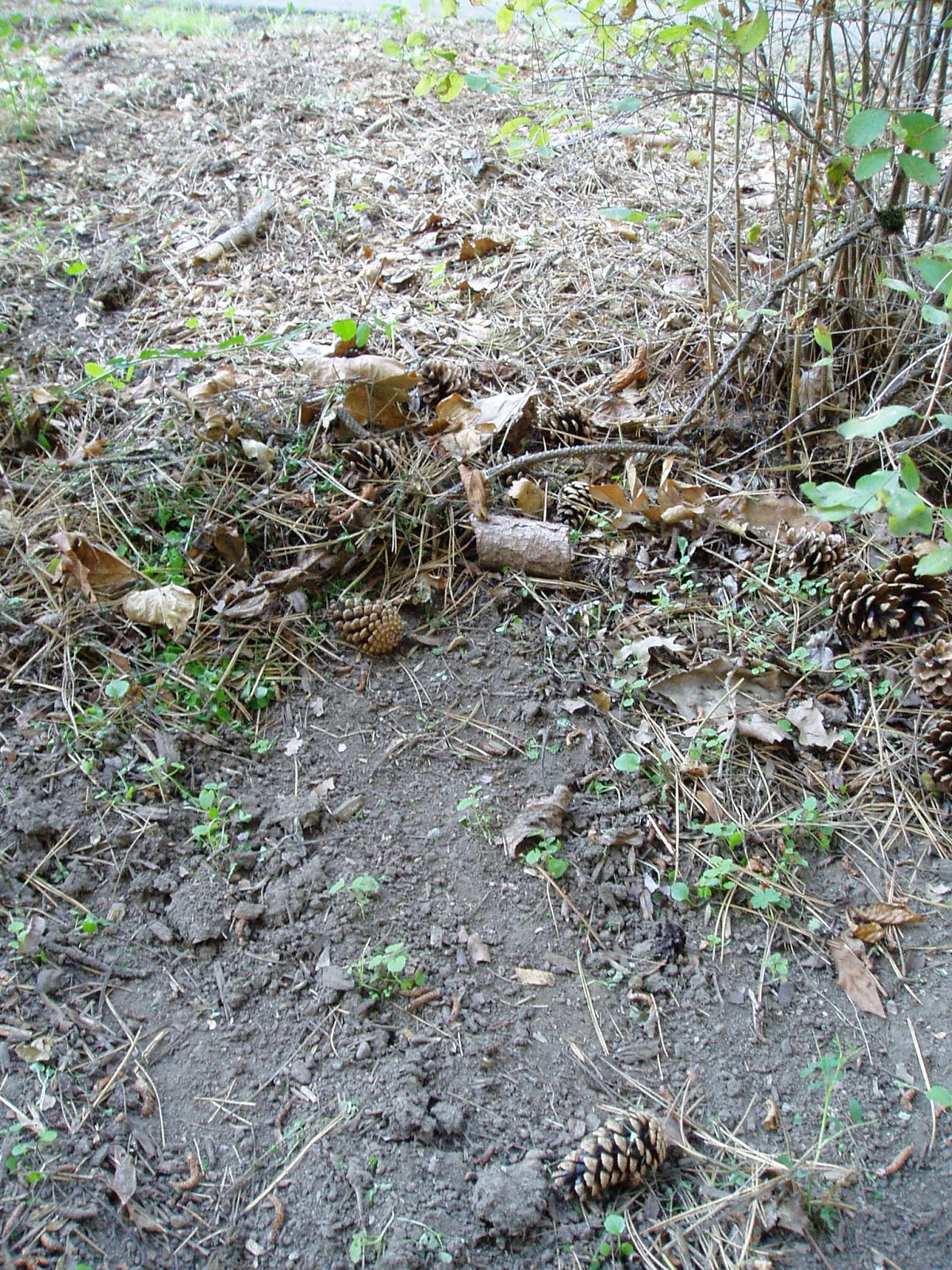
Driving northwest on Ballinger Way (WSR 104) from O. praticola's northern-most known location in Washington (Lake Forest Park), I spotted numerous pines near the Shoreline-Mountlake Terrace town line.  After finding several potential sites to be cone-free, I found my collection site in the parking lot of a business: a pair of western white pines (Pinus monticola) growing in a small planting bed surrounded entirely by asphalt.  The fallen cones were laying on needle litter or in the groundcover, which was comprised of English ivy (Hedera helix) and a ground-hugging variety of juniper (Juniperus sp.).

Fallen cone microhabitat
Tachygyna vancouverana female
I tapped 50 cones and collected 42 spiders and 2-3 species.  Sixteen of the spiders appeared* to be female Tachygyna vancouverana (Linyphiidae).  How refreshing to find a native species proliferating in Seattle-area fallen cones!

The other identifiable species was my target species, the introduced crab spider O. praticola (see photos below).  So, the nexus of Ballinger Way, 15th Ave NE and 244th St SW in Shoreline now marks the northern-most known location of Ozyptila praticola in Washington.  The search continues.

*As always, thank you to Rod Crawford for helping me with IDs.
Ozyptila praticola female, ventral view
Ozyptila praticola female, dorsal view.

Saturday, October 10, 2015

8-Oct-2015 Mukilteo and Lynnwood, Washington

Site location map. Click to enlarge.
My plan was to visit the campuses of community colleges in Everett and Edmonds, where I knew pine trees were growing, to continue exploring western Washington pine cone spiders (most of my data is from eastern Wash.) while also gaining insight into the local distribution of the introduced crab spider Ozyptila praticola.

No cones at Everett CC!
Of course my plan relied on the presence of open fallen cones beneath trees that I had legal access to.  As it turned out, those basic requirements were hard to fulfill.  For starters, the groundskeepers at Everett Community College had fastidiously removed the undergrowth and plant litter from their planting beds.  So had Everett city park crews, as I found while looking for cones beneath pines along Marine View Drive (red pins on map).  I was delighted to see that the ground layer habitat was largely intact at Edmonds Community College, but sadly the scales on the fallen cones were closed there as well as at two other sites (blue pins on map).  The two towering pines on Bothell's Main Street were fenced off due to construction (yellow pin on map).

SW of Paine Field, Mukilteo

Fallen cones at site SW of Paine Field
A pine grows in an industrial park
But persistence paid off!  Cruising south down Mukilteo Speedway, I spied a western white pine (Pinus monticola) growing behind Adpro Litho.  And laying beneath it on a bed of pine needles were about 150 open cones!  The folks in Adpro's office cheerfully gave me permission to collect spiders ("take them all!"), so I was finally in business.  Note that this site is labeled "SW of Paine Field" on the map above.

Juvenile Tegenaria in retreat in cone
Tiny salticids, 2.5 mm long
I tapped 100 cones and collected 30 spiders and 4 species, as well as 7 harvestmen.  Half of the spiders were juvenile Tegenaria sp. (Agelenidae).  The second-most common spider was a salticid*.  Most of the remaining spiders were linyphiids.
*Update (17-Nov-2015): The salticid was Pseudeuophrys lanigera, a European species.  Read more here.

*Update (25-Jan-2018): You can read our subsequent paper about P. lanigera in Washington state here or here.

East of Scriber Lake, Lynnwood

A tiny green island in a sea of
pavement and razor wire.
Urban cones in Lynnwood
"Accidental" pine trees growing in neglected places seemed to be the theme of the day.  My second collecting site was another western white pine growing next to a pungent dumpster behind Lynnwood Square, a shopping center in Lynnwood.

"Toothy" Erigone sp. male.
Click to enlarge
I was only able to find 25 fallen cones to tap, but they produced 6 spiders and 2 species.  One was a very "toothy" microspider Erigone male (Linyphiidae), which sported numerous denticles on the palpal femur as well as on the edge of the carapace.

I also collected a juvenile Ozyptila sp. which had the same patterning and coloring as O. praticola.  It was a tantalizing find because it indicates that the species is probably in the area, but doesn't prove it.

Western white pine (Pinus monticola) terminal bud

Tuesday, October 6, 2015

How widespread is Ozyptila praticola in Washington state?

Ozyptila praticola collection sites in Washington
In 1953 Willis Gertsch reported that a male Ozyptila praticola (Thomisidae) had been collected at an unspecified location in Seattle, Washington the previous summer.  Of this discovery Gertsch wrote, "This is the first record of a Palearctic Ozyptila from North America. The single male agrees in detail with specimens from Finland. Whether the species is established in Washington or is a casual introduction must still be ascertained."

Since then, Rod Crawford and others, including myself (here and here), have collected the species from several localities in northern Seattle (red pins, right).  So the species appears to be well established in the city, but how widely it has disbursed into the state, assuming that Seattle was the point of introduction, is still an open question.  It was found in several locations near Vancouver, British Columbia in 2009 (Bennett et al., 2014), but its present status there is unknown.

To get a clearer picture of O. praticola's local distribution, I've started tapping pine cones both to the north and to the south of the spider's known locations in Seattle.  What follows are descriptions of my first two such forays (see green pins on map).

24-Sept-2015 Beer Sheva Park, Seattle, Washington

Beer Sheva Park cone site
Fallen cones on needle litter
Beer Sheva Park is a typical urban park with small groves of conifers bordered by lawn and pavement.  I tapped Pinus nigra cones found on the lawn as well as those resting on needle litter.

Tapping 100 cones I collected 30 spiders and 12 harvestmen.  Ozyptila praticola was the only identifiable species in the sample and was represented by 1 female, 1 male and 15 juveniles.  It was my impression that they were present only in cones lying on needle litter, but not in cones lying on grass.

As I was returning to my car, a woman walking by asked me about my net.  Upon hearing my explanation, she cheerfully introduced herself and asked me to tell the group she was with what I was doing.  As it turned out, this was a group from a nearby addiction recovery center, out to get some fresh air and enjoy a bit of nature (the park borders on Lake Washington).  They were quite interested to see my specimens, and asked thoughtful questions.  It was a pleasant way to end my morning.

30-Sept-2015 Lake Forest Park, Washington

Lake Forest Park cone site
Fallen cones on soil and litter
A lone Pinus nigra located at the intersection of the Burke-Gilman Trail and Ballinger Way in the city of Lake Forest Park provided me with ample cones to tap.  The cones were lying on bare soil or mixed needle and cottonwood litter.

From 50 tapped cones I collected an astounding 70 spiders and 42 harvestmen.  Ozyptila praticola was the most numerous spider species, with 3 females, 1 male and 23 juveniles present.  Enoplognatha sp. (Theridiidae) was the second most numerous spider, with 16 juveniles.  At least some of those many harvestmen were Paroligolophus agrestis.  In other words, these cones were teeming with introduced species.

Spider in its prey capture web in cone
Three introduced species in one view
The samples from Beer Sheva Park and Lake Forest Park indicate that O. praticola has spread along the entire 15 mile (23 km) length of Seattle.  I'm going to have to start looking for them farther afield. 

Terminal bud and immature seed cone from Pinus nigra tree, Beer Sheva Park

Monday, October 5, 2015

4-Oct-2015 Brant Lake, New York

Site location. Click to enlarge.
Yes, I arrived at my nephew's wedding last weekend with my spider net.  Because what better way to honor him and his new spouse than by advancing pine cone spider science at their wedding venue?  The towering eastern white pines (Pinus strobus) growing at Jimbo's Club At The Point in the beautiful Adirondack region of New York are one of the features that makes the location so picturesque.  And as I confirmed the day after the wedding, their fallen cones are a microhabitat for spiders.

Lots of fallen cones around the cabins
Fallen P. strobus cones
We had to be packed and away by 11 am, so while others lingered over breakfast conversation, I zipped outside early for a round of morning cone tapping.  The morning was a brisk 50 F at most, but the sun was pleasantly warming, the lake was glittering, and woodpeckers, chickadees, and some very vocal red squirrels (Tamiasciurus hudsonicus) provided a pleasant audioscape.

Erigonine male, only about 1mm long
I tapped 50 cones and got 10 spiders and 2 species as well as one harvestman.  I was able to easily identify the two female Ozyptila praticola (Thomisidae) spiders in my sample since I find them regularly in fallen pine cones here in Seattle, Washington.  The identity of the second species remains to be determined, but is a male linyphiid from the Erigoninae subfamily (right).  The rest of the spiders were juveniles from the families Dictynidae, Linyphiidae (different species from the mature specimen), Philodromidae, and Theridiidae.  I don't find philodromines very frequently in fallen cones, but aside from that this seemed a very typical cone sample.

The state of New York is now on the World Map Of Pine Cone Spiders.

Red maple (Acer rubrum) leaves were transitioning from green to scarlet.

Friday, September 18, 2015

Spiders Cannot Be Identified By Color And Pattern Alone


Atypical Araneus diadematus
female photographed in
Seattle, Washington, USA
Typical appearance of
Araneus diadematus female.
Photo by Friedrich Böhringer
My neighborhood is absolutely festooned with the introduced orb-weaver Araneus diadematus (Araneidae).  By late summer, hardly a shrub or a structure is devoid of one of these orange and brown spiders with the striking white pattern on the dorsum (left).  So I got excited when I spotted a large orange orb-weaver (right) on my balcony that lacked the color and patterning of A. diadematus.  Could a native species of orb-weaver actually be thriving in Seattle, at my house?!

Answer: No, not in this case.

Genitalia of an atypically colored and patterned
Araneus diadematus female from
Seattle, Washington USA.
The spider in question is fairly large (over 0.5 inch long) with distinctive external genitalia, so I was able to identify her with reasonable certainty from a photo (right) as an A. diadematus. (Most species are much too small and/or have genitalia too complex to be identified via photos.)  Despite this spider's exotic appearance, she was just "more of same", albeit atypically colored and patterned.

So, as nice as it would be to identify spiders in the field from easily observable traits like color and pattern, such features aren't necessarily diagnostic and in fact can be misleading.  The only way to identify spiders with certainty is by examining the shape of their genitalia and other tiny, immutable features under a microscope.

Saturday, September 12, 2015

In Search Of Leslie Maurice Cockerell (1872-1943), Collector of Euryopis formosa (Theridiidae) Holotype

Nathan Banks (1908) cited L. M. Cockerell as the
collector of the E. formosa holotype
"By himself, a collector has no sort of scientific value, but he often secures material which may be turned to good account in other hands." ~~ T. D. A. Cockerell

When I was assembling the data presented in How widespread is Euryopis formosa's relationship with pines?, I noticed that Nathan Banks (1908) named L. M. Cockerell as the collector of the E. formosa holotype.  I became curious about the person who collected the first described specimen of a species that has enthralled me for several years.  Who was L. M. Cockerell?  How did this person come to be collecting spiders in Bear, Idaho over 115 years ago, and how did the specimen come to be in the hands of Banks, a prominent entomologist?

My research* revealed that L. M. Cockerell was Leslie Maurice Cockerell, born in Beckenham, County Kent, England in 1872 to Sydney John and Alice Elizabeth (née Bennett) Cockerell.  His siblings included the naturalist and bee expert Theodore Dru Alison "T.D.A." Cockerell (1866–1948), director of the Fitzwilliam Museum Sydney Carlyle Cockerell (1867-1962), book illustrator Olive Juliet Cockerell (1869-1910), book binder Douglas Bennett Cockerell (1870-1945), and actress Una Agnes Cockerell (about 1875-about 1944).

After spending his late teens and early adulthood years in Madeira, eastern Canada and the western United States, Leslie would eventually become a "mining engineer who is representing large English mining interests" in Mexico and then later serve as captain in the British Army "in charge of Mineral Resources Development Department, Ministry of Munitions".  Leslie married Gladys Marguerite [unknown maiden name] (1880-1969) at some date unknown to me, but presumably before the couple set sail together from an American port in 1907.  He died in London, England on 24 April 1943.

Location of Bear, Idaho (click to enlarge)
Unfortunately, the date that Leslie collected the E. formosa holotype in Bear, Idaho went unrecorded by Banks (1908) or by Harvard University's Museum of Comparative Zoology, which currently houses it.  I suspect that Leslie collected the specimen sometime between 1890 and 1894, for the following reasons.

First, letters written between 1887 and 1890 by Leslie's brother T.D.A. Cockerell during his convalescence from tuberculosis in Colorado indicate that Leslie was in Madeira 1887-1888 and eastern Canada 1888-1890, but never traveled to the western United States while T.D.A. was there (Weber, 2004).  In June of 1890, shortly before T.D.A. returned to England, T.D.A. wrote that "Mother's postcard (received today) makes me rather anxious.  It seems Leslie will probably have to come to Colorado.  I must see about this on my return." (p. 550).  Thus, the earliest that Leslie could have been in the western United States was the latter half of 1890.  Second, Leslie was in Colorado by 1892 according to the "May 1891 to April 1892" issue of the journal Nautilus, which published a note from "Leslie M. Cockerell, writing from Norwood, San Miguel Co., Colorado" (p. 83).  Third, in 1894 Nathan Banks described a harvestman that Leslie had also collected in Bear, Idaho.  Assuming that he collected the harvestman and the E. formosa on the same visit to Bear, the 1894 publication provides the closing bracket. Record of Leslie sailing on the ship Anchoria from New York City to Glasgow, Scotland in June, 1895 seems to confirm the end of that particular trip to the United States.

Update (Oct 30, 2015): Leslie Cockerell returned again to Idaho by the latter half of 1898, according to two sources.  A notice in the Sunday, July 31, 1898 issue of Idaho Statesman (Boise) stated: "HOTEL ARRIVALS. Capitol. ... Leslie M. Cockerell, Payette".  Additionally, the University of Colorado Boulder Library archives holds a letter dated December 7, 1898 that Leslie sent from Payette, Idaho to his brother T.D.A. Cockerell.  Payette is located about 50 miles south of Bear.  Thus it is possible that Leslie again visited Bear on this subsequent trip to the American West.

As for why Leslie traveled to the American west, what he experienced there, what impressions it left on him, or even why he collected spiders and how his arachnid specimens ended up in Nathan Banks's collection, those questions remain unanswered.  If Leslie Cockerell left a diary or memoir, I have found no mention of it.  Perhaps letters by Leslie or about him await reading in the archived papers of Nathan Banks (Cambridge, Massachusetts), T.D.A. Cockerell (Boulder, Colorado) or Sydney Carlyle Cockerell (Boston, Massachusetts; London, England; etc.).  Alas, I'm unlikely to visit any of those places anytime soon.  I hope others who are more conveniently located will bring any remaining information to light.  T.D.A. took great delight in young Leslie's "first rate" letters to him (Weber, 2004), so if any survive in archives, they're probably a good read.

As T.D.A.'s quote at the top of the post recognizes, people like Leslie who aren't career scientists but rather "just" science hobbyists, volunteers or assistants play important roles in the advancement of science.  Scientific institutions everywhere are enhanced by their contributions, but they themselves are not memorialized in academic archives or biographies.  Their stories are lost to the history of science.  We should make an effort to remedy that.

Literature Cited

Banks, Nathan. 1894. Washington Phalangida, with description of a new southern Liobunum. The Canadian Entomologist, 26(6):160-164.

Banks, Nathan. 1908. New species of Theridiidae. The Canadian Entomologist 40:205-208.

Weber, William A. (Ed.) 2004.  The Valley of the Second Sons: Letters of Theodore Dru Alison Cockerell, a Young English Naturalist, Writing to His Sweetheart and Her Brother about his life in West Cliff, Wet Mountain Valley, Colorado 1887-1890. Pilgrims Process, Inc., Santa Fe, New Mexico. 592 pages.

*To piece together this story I conducted online Google and Ancestry.com searches, read Trevor Kincaid's correspondence with Nathan Banks and T.D.A. Cockerell, and read The Valley of the Second Sons (Weber, 2004).